Seoul currency exchange is easiest and most affordable at the private money changers clustered in Myeongdong, where rates consistently beat banks, airport counters, and ATMs. If you’re arriving at Incheon or Gimpo and wondering where to change money in Seoul, the short answer is: exchange a small amount at the airport for immediate cash needs, then head to Myeongdong for the bulk of your currency exchange once you’re in the city. Beyond Myeongdong, you have several other realistic options — bank branches, global ATMs that accept foreign cards, 24-hour self-service kiosks like WOWPASS, and simply paying by card almost everywhere. Which option makes sense depends on how much cash you need, how much time you have, and whether your home bank charges foreign transaction fees.
Key Takeaways
- Myeongdong money changers offer Seoul’s best cash exchange rates — better than airports, banks, or ATMs.
- Bring clean, large-denomination USD bills (ideally $100s) for the best rates; a passport is required for every exchange.
- Global ATMs in convenience stores (GS25, CU, 7-Eleven) and major banks accept foreign cards 24/7, but charge about ₩3,000–₩5,000 per withdrawal plus possible home-bank fees.
- WOWPASS and other 24-hour self-service kiosks are convenient outside Myeongdong’s hours, at a slightly lower rate.
- Visa and Mastercard are accepted almost everywhere in Seoul, so cash is mainly needed for markets, street food, and T-Money top-ups.
Where to Exchange Currency in Seoul: The Quick Answer
Seoul currency exchange is cheapest at licensed money changers in Myeongdong, moderate at banks, and least favorable at airport counters — but each option serves a different situation. For most travelers, the practical approach is a hybrid: exchange a small amount (around $50–100) at Incheon or Gimpo Airport right after landing to cover taxis, snacks, and a T-Money card top-up, then do your main exchange in Myeongdong once you’ve settled in. Airport rates typically run a few percent worse than Myeongdong because you’re paying for convenience, so avoid changing large sums there. If you’re staying outside central Seoul or arrive late at night, 24-hour kiosks and global ATMs fill the gap when storefronts are closed.
Is it better to exchange money before arriving in Korea?
Generally no — Korean won is not commonly stocked at foreign banks and home-country airport kiosks tend to offer worse rates than what you’ll find in Seoul. It’s usually more cost-effective to arrive with a modest amount of USD cash and exchange it locally at Myeongdong rather than converting your home currency to won before the trip.

Myeongdong Currency Exchange: The Best Rates in Seoul
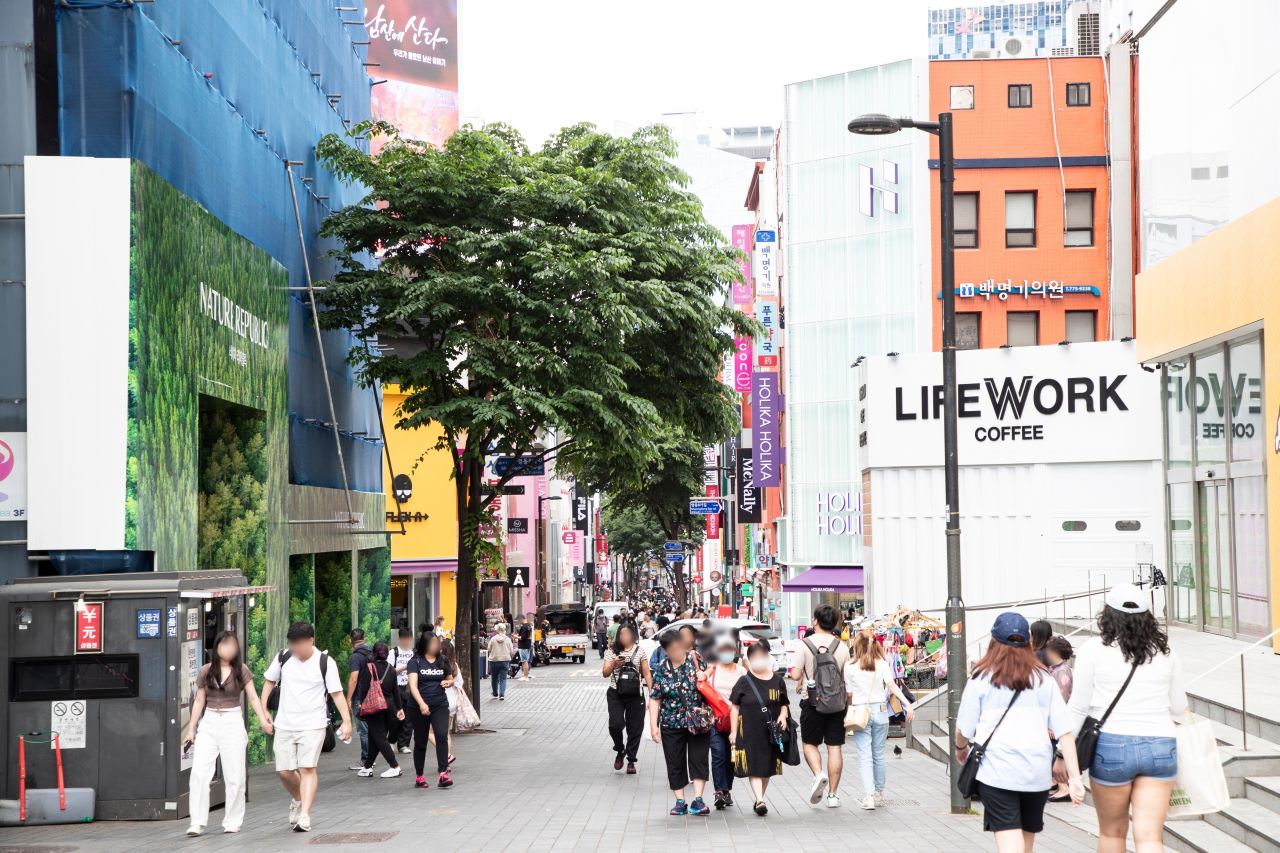
Myeongdong is Seoul’s currency exchange hub, and its private money changers consistently post the best rates in the city, often noticeably better than banks or airport counters. The highest concentration of exchange shops sits along Myeongdong 2-gil near the old Chinese Embassy, plus a cluster of shops near Myeongdong Station Exit 5 and along Namdaemun-ro. Because so many shops compete within a few blocks, it’s worth comparing two or three before committing — posted rates can shift throughout the day and vary slightly between neighboring storefronts.
Well-known options include Daesagwan-ap Hwanjeon (Embassy Exchange) at 26 Myeongdong 2-gil, right by the former Chinese Embassy (Naver Map / Google Maps); K Exchange Myeongdong Branch, about a five-minute walk from Myeongdong Station Exit 5 at 39 Myeongdong 8na-gil (Naver Map / Google Maps); and Money Box Myeongdong Branch at 52-1 Namdaemun-ro (Naver Map / Google Maps), which also has branches near Gwangjang Market, Gwanghwamun, and Seoul Station for travelers who won’t be near Myeongdong on other days. There’s also Myeongdong Hwanjeonso on Euljiro, another long-running option in the same district.
Most Myeongdong exchange shops open around 9 or 10 a.m., with closing times varying from as early as 7 p.m. to as late as 10 p.m. (as of 2026), with hours sometimes varying on public holidays — check the specific shop before making a special trip late in the day. Bring your passport, since it’s required for every transaction, and keep in mind that shops sell foreign currency and buy it back at different rates, so ask which one applies before handing over cash.
Why does bill size affect the exchange rate?
Money changers generally give a better rate for larger denominations, especially $100 bills, than for $20s or $50s, because large bills are cheaper for them to process and resell. If you’re bringing USD to exchange, ask your home bank for clean, newer $100 notes rather than a stack of small bills to get the most favorable rate in Myeongdong.
Bank vs Airport vs ATM: Comparing Your Exchange Options
Each currency exchange option in Seoul trades off convenience, cost, and cash-on-hand speed, so the right choice depends on timing and how much you need. Here’s how the main options compare:
- Myeongdong money changers — Best rates in Seoul; requires a passport; limited to shop hours (roughly 9/10 a.m. opening, closing anywhere from 7 to 10 p.m.); best for exchanging your main travel budget once you’re in the city.
- Airport exchange counters (Incheon, Gimpo) — Least favorable rates but open around flight hours; convenient for grabbing initial cash for taxis and T-Money; best used only for a small amount right after landing.
- Bank branches (Shinhan, KB Kookmin, Woori, Hana) — Rates are better than airports but usually not as good as Myeongdong; hours are typically 09:00–16:00 on weekdays only; useful if you’re near a branch during banking hours or want a licensed institution.
- Global ATMs — Available 24 hours in convenience stores (GS25, CU, 7-Eleven, Emart24), subway stations, and bank lobbies; charges about ₩3,000–₩5,000 per withdrawal in local fees, plus whatever your home bank charges; best for topping up cash outside Myeongdong’s hours or in other neighborhoods.
- WOWPASS and 24-hour kiosks — Rates run slightly below Myeongdong (roughly ₩5,000–₩10,000 difference on a $500 exchange, as of 2026) but operate around the clock and issue a reloadable payment card; best for late-night arrivals or when Myeongdong shops are closed.
If your priority is the absolute best rate and you can time your visit during shop hours, Myeongdong wins. If you need cash at 2 a.m. or you’re staying far from Myeongdong, a global ATM or a WOWPASS kiosk is the more realistic choice, even at a slightly worse rate.
Using ATMs in Seoul: Fees, Limits, and Which Banks Are Cheapest
Foreign-card ATMs are widely available across Seoul and are the most practical backup to Myeongdong, but they come with layered fees worth understanding before you rely on them. Look for machines labeled “Global ATM,” which accept Visa, Mastercard, and JCB cards and are found in convenience stores, subway stations, airports, and the lobbies of major banks like Shinhan, KB Kookmin, Woori, and Hana. Many of these are open 24 hours, making them the go-to option when exchange shops are closed.
Local Korean ATM fees generally run about ₩3,000–₩5,000 per withdrawal (as of 2026). Among the major banks, KEB Hana Bank and Woori Bank ATMs tend to charge somewhat lower local fees, around ₩3,500–₩4,000 per transaction (as of 2026), which can add up if you’re withdrawing multiple times across different neighborhoods — Myeongdong, Hongdae, Gangnam, and Itaewon all have Hana and Woori branches with ATMs. On top of the local fee, your home bank may charge a separate international withdrawal fee (often about USD 3–5) and a foreign transaction fee (typically 1–3%), so a no-foreign-fee debit card — the kind offered by services like Wise or Revolut — can meaningfully cut your total cost per withdrawal. Korean ATMs generally cap withdrawals at around ₩300,000–₩400,000 per transaction in convenience stores, while bank ATMs may allow up to ₩1,000,000 per transaction, though some banks like Hana Bank have limits of around ₩700,000, so plan for multiple withdrawals if you need more.
Do I need to notify my bank before using ATMs in Korea?
Yes — notify your home bank of your travel dates before you leave, since unannounced overseas withdrawals are a common reason foreign cards get declined at Korean ATMs. It’s also worth carrying a backup card in case one is rejected, since not every machine accepts every card network.
Paying by Card vs Cash in Seoul: How Much Cash Do You Really Need?
Cash is no longer essential for most of a Seoul trip, since Visa and Mastercard are accepted almost everywhere, but you’ll still want some won on hand for specific situations. Restaurants, cafes, department stores, convenience stores, and most shops in Myeongdong, Hongdae, and Gangnam take cards without issue. Where cash still matters is at traditional markets like Gwangjang Market, from street food vendors, at some smaller family-run restaurants, and for topping up a T-Money transit card, since not all T-Money kiosks or bus readers accept card top-ups.
A practical rule of thumb: keep about ₩50,000–100,000 in cash on hand for markets and transit, and put everything else on a card. This also reduces how much you need to carry after your Myeongdong exchange and lowers the risk if cash is lost or stolen.
Common Mistakes and Practical Tips for Exchanging Money in Seoul
The biggest mistake first-time visitors make is exchanging most of their trip budget at the airport, where rates are consistently worse than in Myeongdong — exchange only enough to get into the city and grab a T-Money card, then do your main exchange later. Another common pitfall is bringing a mix of small USD bills instead of $100 notes, which yields a worse rate per dollar at Myeongdong shops.
Some vendors and self-service machines are card-only, so don’t assume every kiosk or small shop takes cash, and don’t assume every stall takes card either — carrying both is the safest bet. Rates for the same currency can vary slightly between neighboring Myeongdong shops, so a quick comparison of two or three storefronts before exchanging a large amount is worth the extra five minutes; some travelers also check daily rate updates on currency-focused social accounts before heading out. Finally, always bring your passport — it’s required for every currency exchange transaction in Korea, whether at a bank or a private money changer, and transactions at licensed Myeongdong shops are generally quick with minimal paperwork required.
Frequently Asked Questions
Where are the best places to exchange currency in Seoul?
Myeongdong money changers, especially those clustered near the former Chinese Embassy on Myeongdong 2-gil and near Myeongdong Station Exit 5, consistently offer Seoul’s best cash exchange rates. Money Box also operates additional branches near Gwangjang Market, Gwanghwamun, and Seoul Station for travelers not staying near Myeongdong.
Are airport exchange rates worse than in the city?
Yes, airport exchange counters at Incheon and Gimpo typically offer less favorable rates than Myeongdong money changers. It’s best to exchange only a small amount at the airport for immediate needs like taxis and a T-Money card, then do your main exchange in the city.
Should I use an ATM or a currency exchange office?
Currency exchange offices in Myeongdong generally offer better value for larger amounts of cash, while ATMs are best for convenience outside shop hours or in other neighborhoods. ATMs charge about ₩3,000–₩5,000 per withdrawal in local fees plus possible home-bank fees, so they work best paired with a no-foreign-fee debit card.
Do Myeongdong exchange shops charge hidden fees or accept currencies other than USD?
Reputable Myeongdong shops typically don’t charge a separate fee — the cost is built into the buy/sell rate spread, so it’s worth comparing a couple of shops before a large exchange. Most handle major currencies including USD, EUR, JPY, CNY, and others, though USD generally gets the most favorable rate.
Do I need a passport to exchange money in Korea?
Yes, a passport is required for every currency exchange transaction in Korea, whether at a Myeongdong money changer or a bank branch. Bring the physical passport rather than a photo or copy, as shops need to verify it in person.
In Conclusion
For most travelers, the smartest approach to Seoul currency exchange is layered: change a small amount at the airport for immediate cash needs, then head to Myeongdong for the bulk of your exchange, where rates consistently beat banks, airports, and ATMs. Bring clean $100 bills and your passport, compare two or three Myeongdong shops before a large exchange, and lean on global ATMs or WOWPASS kiosks when you need cash outside shop hours or in other neighborhoods. Since cards are widely accepted across Seoul, you likely need less cash overall than you’d expect — keep enough won for markets, street food, and T-Money top-ups, and put everything else on a low-fee card. With these basics in place, currency exchange becomes a five-minute errand rather than a source of trip-planning stress.
Discover more from Korea Visiting
Subscribe to get the latest posts sent to your email.