Insadong traditional craft shops are scattered across a maze of alleys behind Anguk Station, and figuring out which ones sell the real thing takes more than a quick stroll down the main street. Walk in without a plan and you’ll pass dozens of stalls selling near-identical fans, magnets, and “hanbok dolls,” most of them mass-produced and imported — while the shop actually hand-carving seals or hand-making hanji paper sits quietly one alley over, easy to miss. I’ve spent enough time wandering this neighborhood to know the difference between a souvenir stand and a working craft studio usually comes down to which street you’re standing on, not which storefront looks the most polished. This guide sorts through Insadong’s shopping district — from the spiral ramps of Ssamziegil to the century-old halls of Tong-In Store — so you spend your visit finding genuine pieces instead of guessing.
Key Takeaways
- Insadong’s main street (Insadong-gil) is packed with tourist-facing stalls; the more authentic, artisan-run shops sit in the side alleys off the main drag.
- Ssamziegil and Tong-In Store are the two anchor stops — one for modern craft-meets-design goods, one for serious traditional art and antiques.
- Anguk Station (Line 3), Exit 6, is the most direct subway approach; Jonggak Station works if you’re coming from the south.
- For a guaranteed “made in Korea” souvenir, government-backed venues exist as a fallback when you’re unsure about a shop’s sourcing.
- Custom seal (dojang) engraving is one of the few genuinely personal, portable souvenirs you can commission on the spot in Insadong.
📍 Insadong Cultural Street — Essential Information
| Address | Insa-dong, Jongno-gu, Seoul Metropolitan City |
| Opening hours | Open 24 hr |
| Closed | Open all year round |
| Parking | Not available |
| Website | korean.visitseoul.net |
| Map | Google Maps · Naver Map |
Insadong Cultural Street at a Glance
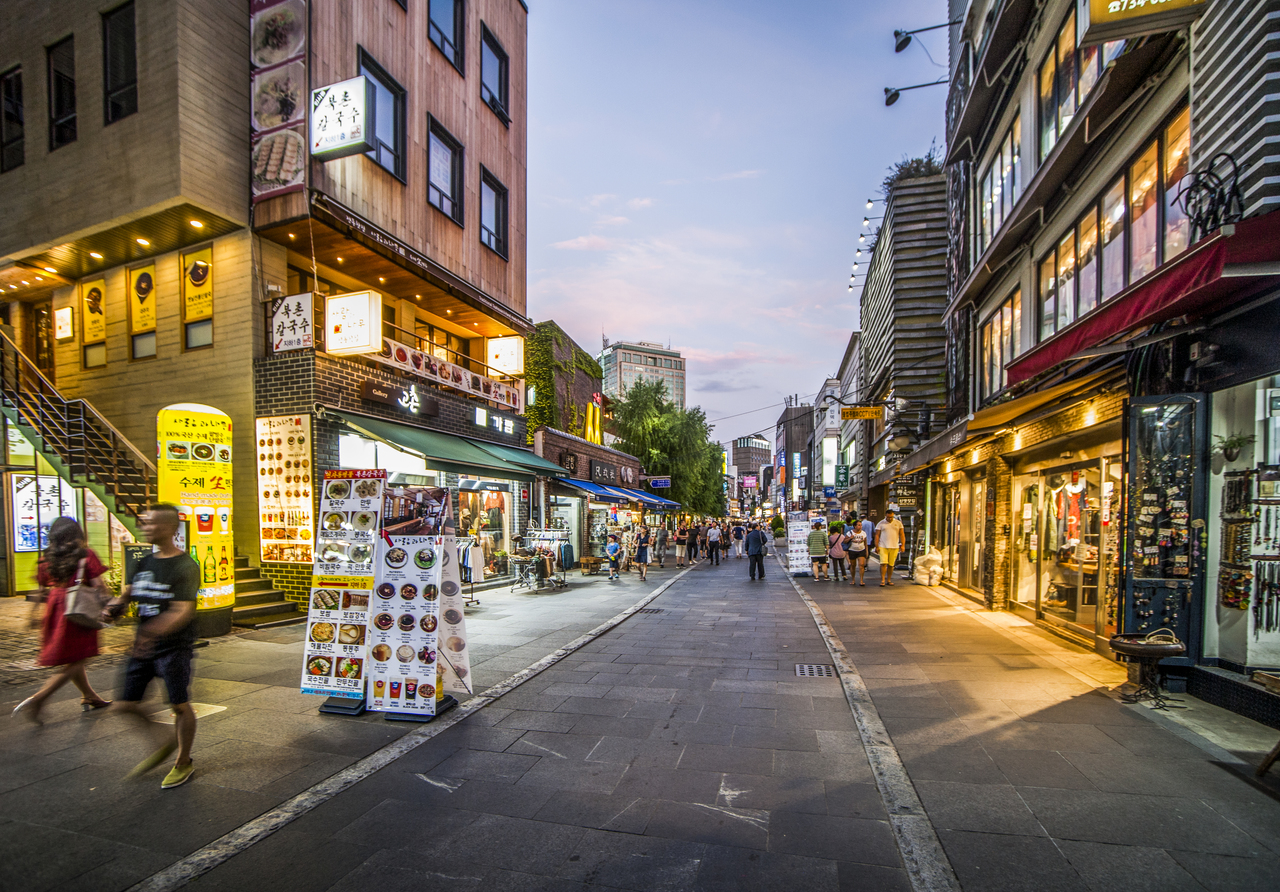
- Why visit: It’s the one place in Seoul where an entire street of storefronts still uses Hangeul signage instead of English or logos, and where traditional galleries, teahouses, and craft studios sit side by side.
- What you’ll see and experience: Paper lantern-lined lanes, hanji (mulberry paper) goods, celadon and buncheong pottery, calligraphy brushes, hanbok accessories, and — on evenings and weekends — street performers and buskers working the crowd near the main plaza.
- Getting there: Anguk Station (Line 3) Exit 6 puts you about a 5-minute walk from the top of the street; Jonggak Station (Line 1) Exit 3 works if you’re arriving from the south, with roughly a 10-minute walk north.
- Tickets and admission: The street itself is free and open at all times; individual galleries, museums, and craft experiences charge separately, and most of those fees are modest.
- Tips from past visitors: Come on a weekday morning if you want the alleys quiet enough to actually browse; Saturday afternoons draw the heaviest foot traffic and the loudest street vendors.
- Nearby spots worth combining: Ssamziegil sits right on the main street, and the Beautiful Tea Museum is a short walk further down — both make natural stops on the same visit.

How to Tell Authentic Insadong Traditional Craft Shops from Tourist Souvenirs
The fastest way to spot a genuine traditional craft shop in Insadong is to check whether the item is made or finished on-site — if a shop can show you a workshop, kiln, or workbench, it’s almost certainly legitimate. The stalls lining the main pedestrian street tend to sell the same handful of items — folding fans, keychains, “traditional” magnets — at nearly identical prices, and a lot of that stock is imported rather than Korean-made, a complaint I hear from first-time visitors more than almost anything else about this district.
The shops worth your money usually share a few traits: they’re set back in a side alley rather than fronting the main road, they display a maker’s name or gallery affiliation rather than generic branding, and the staff can tell you which region or kiln a ceramic piece came from. Multi-vendor buildings like Tong-In Store and Ssamziegil solve a lot of this guesswork for you, since the shops inside are curated or juried rather than open to any vendor who wants a storefront. If a price feels suspiciously low for a hand-thrown ceramic bowl or a hanji notebook, that’s usually the signal to keep walking rather than a bargain.
One habit worth building: ask directly whether a piece is handmade in Korea before you buy. Reputable shops answer without hesitating and are often proud to explain the process — folding hanji into laminated layers, or applying mother-of-pearl inlay (najeon chilgi) sheet by sheet. Vendors reselling imported goods tend to deflect the question or change the subject to price.
Ranking the Best Insadong Traditional Craft Shops to Visit
The strongest Insadong traditional craft shops fall into two categories — large curated complexes housing dozens of vendors, and small single-maker studios tucked into side alleys — and a well-planned visit hits at least one of each. Below are six stops I’d actually build a route around, several of them multi-floor buildings that function like mini craft villages on their own.
1. Ssamziegil
This is the shop most first-timers photograph before they’ve even bought anything — a spiral-ramp building wrapped around a central courtyard, with small craft and design stalls lining every level. It’s less “traditional” and more “traditional craft reinterpreted for modern taste,” which makes it a good entry point if you want browsable, gift-sized items rather than museum-grade pieces. Ssamziegil sits directly on Insadong-gil, and the mix of independent designers means quality varies stall to stall — worth checking the KCDF-affiliated makers here specifically if you want something closer to traditional craftsmanship. Details: Naver Map · Google Maps · Official site.
2. Tong-In Store
This is my pick if you want to see traditional craft treated seriously rather than as a souvenir category. Billed as Korea’s oldest traditional crafts shopping center, the building houses more than 100 shops and galleries under one roof, spanning ceramics, antiques, calligraphy, and mother-of-pearl inlay work. Give yourself real time here — the ceramics floor alone can eat an hour if you’re comparing celadon pieces, and the antique floor is where I’ve seen genuinely old items sit next to reproductions, so ask before assuming either way. Details: Naver Map · Google Maps.
3. KCDF Gallery
Run by the Korea Craft & Design Foundation, this gallery-and-shop combination is the closest thing Insadong has to a quality guarantee — the pieces sold here are vetted through the same organization that promotes Korean design nationally. It’s a good stop if you want a single, well-made item rather than a haul of smaller souvenirs, and the gallery exhibitions rotate often enough that a repeat visit later in your trip can show you something different. Located at 8 Insadong 11-gil, Jongno-gu, a short detour off the main street. Details: Naver Map · Google Maps.
4. Beautiful Tea Museum Shop
Best known for its museum of historic tea utensils, the Beautiful Tea Museum also runs a shop selling tea leaves and ceramic teaware made by working potters, some of them exhibited artists rather than mass producers. Entry to the museum and gallery is free; the attached teahouse charges per order, with a minimum of one menu item per person if you sit down. It’s an easy pairing with a Ssamziegil visit since both are on the same stretch of Insadong-gil. Details: Naver Map · Google Maps.
5. Hanji Chueok (Recollections)
If you want a hands-on souvenir instead of something bought off a shelf, this small hanji paper studio is the one to know. They run short seminars where visitors fold, layer, and decorate their own hanji pieces — boxes, fans, or notebook covers — and reservations for these sessions are typically accepted only until mid-afternoon, so this isn’t a spontaneous evening stop. It’s tucked into Insadong 7-gil rather than the main street, which is exactly the kind of alley detour worth making. Details: Naver Map · Google Maps.
6. A Government-Backed Souvenir Fallback
If you’ve spent an hour browsing and still aren’t confident about a shop’s sourcing, Insadong is also home to a government-operated souvenir venue where every item is certified made in Korea — a useful safety net for travelers who’d rather pay a known price for a guaranteed-authentic gift than keep guessing at smaller stalls. It won’t have the artisan story of a small studio purchase, but it solves the authenticity question outright.
Beyond the Main Street — Insadong’s Quieter Alleys and Courtyards
The best finds in Insadong rarely sit directly on Insadong-gil itself — they’re one turn off it. Side alleys like Insadong 7-gil, 9-gil, and 11-gil (where Hanji Chueok and KCDF Gallery sit) carry a fraction of the foot traffic of the main street, and that’s usually where the working studios and smaller galleries are. Ssamziegil’s courtyard, tucked behind its street-facing storefronts, is another example — most visitors walk past the entrance without realizing there’s a spiral building’s worth of shops behind it.
I’d treat the main street as your orientation pass and the alleys as where you actually shop. A useful habit: whenever the crowd on Insadong-gil starts to feel thick — which tends to happen around midday on weekends — duck into the nearest side lane. Foot traffic drops sharply within a block, and that’s often where you’ll find a shop owner willing to explain their work in more detail than a busy main-street stall ever would.
Getting to Insadong — Subway Routes and Walking Directions
Anguk Station on Line 3 is the most direct route into Insadong’s shopping district — take Exit 6 and it’s roughly a 5-minute walk south to the top of the main street, putting you right near Ssamziegil and the craft shops clustered around it. If you’re coming from areas served by Line 1 or Line 5, Jongno 3-ga Station is the better transfer point, with a short walk of a few minutes to the Beautiful Tea Museum end of the street. Jonggak Station (Line 1), Exit 3, works as a third option if you’re approaching from the south — expect about a 10-minute walk north to reach the heart of Insadong.
However you arrive, the street itself is pedestrian-friendly and flat, so there’s no need to plan around elevation the way you might for hillside neighborhoods elsewhere in Seoul. Parking isn’t really an option in this area, so public transit or a taxi drop-off at the street entrance is the practical choice.
Other Things to Do in Insadong Besides Shopping
Craft shopping is only part of what fills a visit here — Insadong is also dense with traditional teahouses, small art galleries, and street food stalls that make a natural break between shops. On evenings and weekends, buskers and street performers work the open plaza near Ssamziegil, and that’s when the neighborhood’s atmosphere shifts from browsing-focused to genuinely lively. If you’re pacing a full day around Insadong, I’d plan craft shopping for the morning when the alleys are quiet, save a teahouse stop for the early afternoon lull, and let the main street’s performance energy be your closing act before heading to Anguk or Jonggak Station.
Frequently Asked Questions
Where can I find authentic, high-quality traditional crafts in Insadong, not mass-produced souvenirs?
Prioritize multi-vendor curated buildings like Tong-In Store and KCDF Gallery, where shops are juried rather than open to any vendor, and small single-maker studios in side alleys like Insadong 7-gil and 11-gil. Ask directly whether an item is handmade in Korea — legitimate shops answer without hesitation, while resellers of imported goods tend to deflect the question.
Are there craft shops or handmade-item areas in Seoul besides Insadong?
Insadong remains the most concentrated craft-shopping district in central Seoul, but individual artisan studios are scattered throughout nearby neighborhoods like Bukchon. If you strike out on a specific item in Insadong, a government-operated, made-in-Korea-certified souvenir venue in the same neighborhood is a reliable fallback.
Can I get a custom-made souvenir, like a personal stamp, in Insadong?
Some craft shops and studios in the Insadong side alleys offer seal (dojang) engraving, letting you have your name carved into a traditional Korean stamp for a fee — it’s worth asking at a shop directly, since not every stall provides the service. It’s one of the more personal, portable souvenirs available in the district and doubles as a quick hands-on cultural experience.
How much does it cost to enter the craft shops and galleries in Insadong?
Entry to the street, Ssamziegil, Tong-In Store, and most galleries is free — you’re only paying for what you buy. Paid extras are limited to specific experiences, such as hanji paper-making seminars, seal engraving, or sitting down at an attached teahouse, which typically requires ordering at least one item per person.
What’s the best time of day to visit Insadong’s craft shops?
Weekday mornings are the quietest window for actually browsing and talking with shop owners, since Saturday afternoons draw the heaviest crowds along the main street. If you want the street’s livelier busking and performance atmosphere, come back in the early evening or on a weekend instead.
In Conclusion
Insadong rewards a little strategy over aimless wandering: treat the main street as your warm-up lap, then commit real time to Ssamziegil and Tong-In Store, detour into the side alleys around Insadong 7-gil through 11-gil for smaller studios, and keep the seal-engraving or hanji workshop experiences in reserve for a souvenir with an actual story behind it. Anguk Station Exit 6 gets you in fastest, and a weekday morning visit will save you from the thickest Saturday crowds. Ask before you buy, favor shops tucked off the main drag, and lean on the government-backed venue nearby if you ever want a guaranteed made-in-Korea purchase instead of guessing.
Discover more from Korea Visiting
Subscribe to get the latest posts sent to your email.