Coming out of Mongchontoseong Station with no map plan and a limited afternoon is the exact spot where most first-time visitors to Olympic Park lose an hour just guessing which direction to walk. The park spans a genuinely huge footprint — sports venues, a fortress hill, lakes, sculpture fields — and if you don’t know which exit puts you closest to what, you’ll end up backtracking across the whole site. Exit 1 is the one that matters here: it drops you almost directly at the park’s most photographed cluster of sights, and from there a simple, walkable order lets you hit seven distinct highlights without doubling back. This guide lays out that route stop by stop, from the World Peace Gate through the Baekje-era fortress trail to the museum and lake, so you can move with intention instead of wandering.
Key Takeaways:
- Exit 1 of Mongchontoseong Station is about a 5-minute walk to the park’s main cluster of sights.
- The seven stops — Peace Gate, Lone Tree, Mongchontoseong Fortress, Sculpture Park, 88 Lake, Seoul Baekje Museum, and the bicycle rental area — can be walked in one continuous loop.
- General park admission is free; the Seoul Baekje Museum is also free.
- Mongchontoseong Fortress has a 2.4km walking trail dating to the Baekje period (3rd–4th century).
- Bicycle rentals near the Peace Gate are the easiest way to cover ground if walking the whole loop feels like too much.
Olympic Park at a Glance
- Why visit: a single free-entry park combining Olympic-era landmarks, Baekje-dynasty fortress remains, and open-air art in one walkable loop.
- What you’ll see: the World Peace Gate, the Lone Tree ridge, Mongchontoseong Fortress walls, an outdoor sculpture collection, 88 Lake, and the Seoul Baekje Museum.
- Getting there: Seoul Subway Line 8 to Mongchontoseong Station, Exit 1 — a roughly 5-minute walk puts you at the Peace Gate approach.
- Tickets and admission: the park grounds and the Seoul Baekje Museum are both free; only bicycle rentals carry a fee.
- Tips from past visitors: prioritize the Peace Gate, Lone Tree, and fortress trail early in your visit — these outdoor sights are the park’s real highlights, not the sports venues.
- Nearby spots worth combining: Seokchon Lake is frequently paired with an Olympic Park visit by travelers also heading toward Jamsil.
How to Get to Olympic Park from Mongchontoseong Station
Exit 1 at Mongchontoseong Station is the single most useful detail for anyone planning an Olympic Park Mongchontoseong Station attractions route, because it lines up almost perfectly with the park’s densest cluster of sights. I’ve watched first-timers pop out of a different exit and immediately veer toward the sports stadiums on the far side of the grounds, adding a 15–20 minute detour before they’ve even started. Exit 1 avoids that: walk straight out and within about five minutes you’re standing at the approach to the World Peace Gate, with the sculpture walk and fortress hills already visible ahead. If you’re coming from central Seoul, Line 8 connects through several transfer points, so check your specific route, but once you’re on Line 8 the station-to-park walk itself is short and flat — no confusing overpasses or unmarked side streets to navigate.
Is Mongchontoseong Station the best station for Olympic Park?
For the seven stops covered here, yes. Other entrances (near the tennis center or the velodrome side) put you closer to sports facilities but farther from the Peace Gate, Lone Tree, and fortress trail that make up the park’s signature walk.
World Peace Gate — The Park’s Symbolic Entrance
The World Peace Gate is the structure most visitors photograph first, and it sets the tone for the whole visit as a monument built for the 1988 Seoul Olympics rather than a historical relic. Its sweeping arch and painted ceiling read as more ceremonial than decorative up close — the scale is bigger than photos suggest, and the open plaza in front of it tends to host performers, food carts, or seasonal events depending on the day. From Exit 1, this is the first landmark you reach, which makes it a natural starting point rather than a detour. My take: don’t rush past it toward the fortress — the plaza benches here are a good spot to get oriented with a park map before committing to a direction, since the grounds fan out in several directions from this point.
The Lone Tree — Olympic Park’s Signature Photo Spot
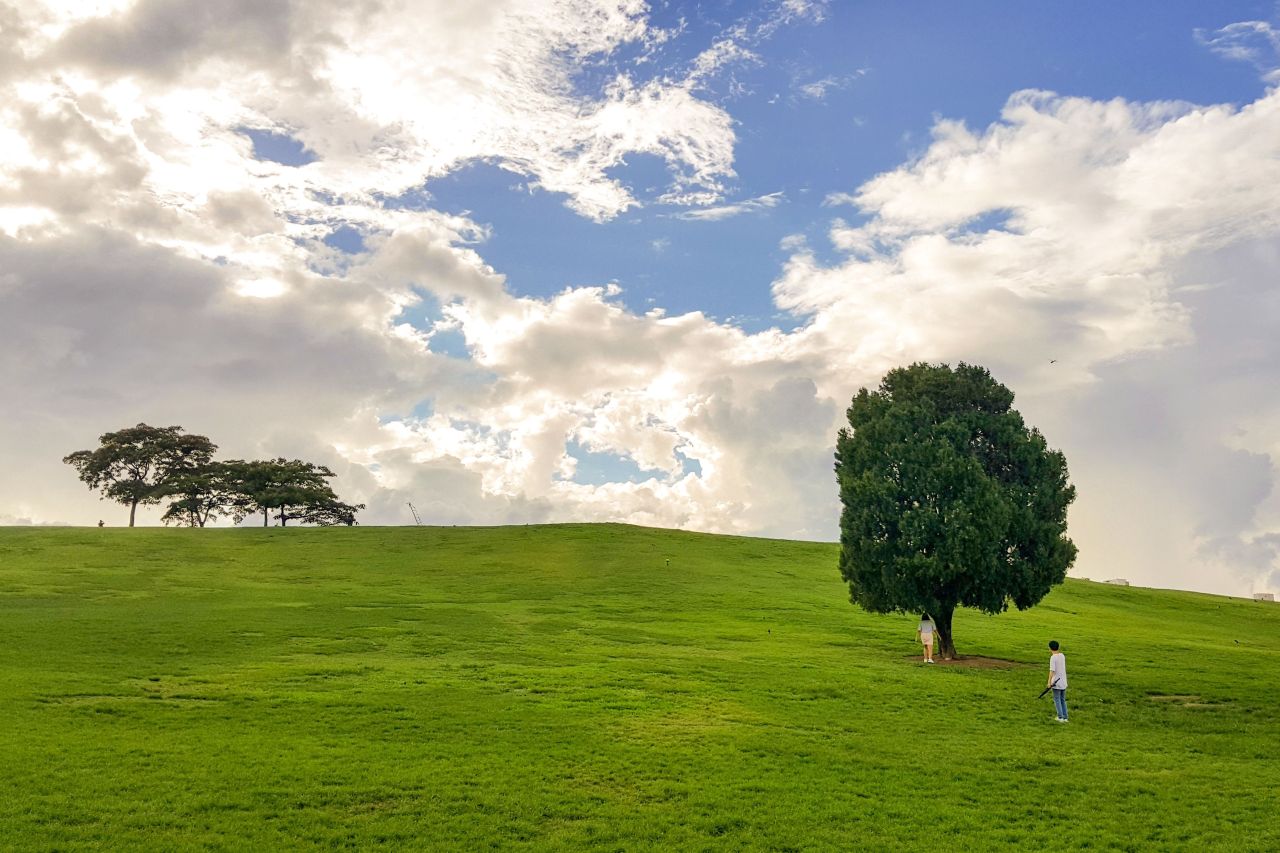
The Lone Tree sits alone on an open grassy ridge and has become one of the most searched, most Instagrammed single trees in Seoul, largely because the composition — one tree, open sky, rolling hill — photographs cleanly at almost any time of day. Getting up close means a short uphill walk from the main path, and on clear weekend afternoons expect a small line of people waiting to get an unobstructed shot without strangers in frame. Early morning or just before sunset are noticeably quieter windows if photos are your priority. Skip the climb if you’re pressed for time and just view it from the lower path — the silhouette reads fine from a distance too, and you’ll save the round trip for the fortress walk ahead.
Mongchontoseong Fortress — Walking the Baekje-Era Earthworks
Mongchontoseong Fortress is an earthen fortification built during the Baekje period, roughly the 3rd or 4th century, and its 2.4km trail is the part of Olympic Park most visitors underestimate before arriving. This isn’t a fortress with visible stone walls or gates — it’s a series of grass-covered mounds and ridgelines that once formed defensive earthworks, and the trail loops around and over them with genuine elevation change. What surprises first-timers is how much of a workout the full loop is; the earthen ridges rise higher than they look from the base, and the path isn’t flat park pavement but packed dirt and grass in sections. If your legs or time are limited, walking just the section nearest the Peace Gate side still gives you the fortress’s atmosphere — wide sky, quiet tree cover, occasional glimpses of the skyline — without committing to the full 2.4km.
Do I need to walk the full 2.4km fortress trail?
No — the trail loops, so you can join and exit at multiple points. Walking the section closest to the Peace Gate and Lone Tree gives a representative sample of the fortress atmosphere in 15–20 minutes, while the full loop suits visitors with more time and comfortable shoes.
Olympic Park Sculpture Park — Open-Air Art Along the Walk
The Sculpture Park is less a single stop than a scattering of large-scale outdoor artworks placed along the walking paths between the fortress and the lake, and it’s the section where a lot of visitors realize they’ve already been passing sculptures without registering them as “the sculpture park.” Pieces range from abstract metal and stone forms to more playful installations, and the setting — open lawns, mature trees, benches at irregular intervals — makes it easy to combine with a slow walk rather than requiring a dedicated visit. If you only have time for a quick pass, treat it as the connective tissue of your route rather than a destination in itself: it naturally bridges the fortress hills to the lake area, so you’ll see a good chunk of it regardless of your exact path.
88 Lake — Olympic Park’s Waterside Rest Stop
88 Lake is the flattest, most low-effort stretch of the entire route, and after the fortress climb it functions as the natural place to slow down. The lakeside stage area and walking path draw joggers, families with strollers, and picnickers spread out on the grass, especially in the late afternoon when the light softens over the water. There’s no admission or activity required here — it’s simply a place to sit, and I’d treat it as your built-in break between the physically demanding fortress trail and the museum stop ahead. If you’re traveling with kids or older relatives, this is the section of the loop that asks the least of them.
Seoul Baekje Museum — Free Context for Everything You Just Walked
The Seoul Baekje Museum is a free museum that explains the archaeological context behind the fortress mounds and earthworks you’ve just walked across, and visiting it after the fortress trail rather than before makes the exhibits land harder. Displays cover Baekje-era artifacts, models of the fortress in its original form, and daily-life reconstructions that make the abstract grassy mounds outside suddenly make sense as a functioning ancient settlement. This is the section of the park most visitors skip because it doesn’t photograph as well as the Lone Tree or the Peace Gate, but it’s the one place that turns “a nice park” into “a site with 1,700 years of layered history.” Budget 30–40 minutes if you want to read the exhibit panels properly, less if you’re just doing a walkthrough.
Bicycle Rentals and Covering Ground Faster
If walking all seven stops sounds like more than your day allows, Olympic Park rents bicycles near the Peace Gate and Woori Financial Art Hall — the park’s old road train service has been discontinued, so bicycles are now the main way to cover ground faster. Two-wheeled bikes for two people (tandem) cost around ₩10,000 for 60 minutes on weekends, while larger four-wheeled bikes seating three or six people cost more, roughly ₩13,000–₩33,000 depending on group size and duration — useful if you’re traveling with kids who can’t walk the full fortress loop. My honest take: bikes are worth it if you’re combining Olympic Park with another stop the same day and need to conserve energy, but if photography and the fortress trail’s texture are your priority, walking captures details a bike ride will blur past.
What about the sports venues and KSPO Dome?
If there’s a concert scheduled at the KSPO Dome, don’t count on hearing it from outside the venue — sound doesn’t carry meaningfully beyond the building, so it’s not a free-listening spot.
Common Mistakes First-Time Visitors Make
The biggest mistake is treating Olympic Park like a single compact attraction you can “see” in 30 minutes — the grounds are large enough that a rushed visit means picking two or three stops at most, not all seven, so decide your priorities before you start walking rather than mid-route. A second common error is exiting the station from the wrong side: exits other than Exit 1 push you toward the sports facilities and add real walking distance to reach the Peace Gate cluster, which throws off any planned route. Visitors also frequently assume the fortress trail is flat park pavement because it looks that way on a map — the earthen ridges have genuine elevation, and showing up in sandals or with a stroller expecting easy footing leads to turning back early.
Frequently Asked Questions
Is Olympic Park good for autumn foliage compared to other Seoul parks?
Olympic Park’s foliage is decent but generally considered less dramatic than Seoul Forest’s, and warm autumns can delay color change further. If fall leaves are your main goal, treat Olympic Park as a bonus rather than your primary foliage destination.
Are picnics allowed near the KSPO Dome during concerts?
Picnicking in the open grounds near the KSPO Dome is generally fine, but don’t expect to hear a concert happening inside — the venue doesn’t carry sound meaningfully to the outside.
How long does it take to see all seven Olympic Park stops from Mongchontoseong Station?
A full loop covering the Peace Gate, Lone Tree, fortress trail, Sculpture Park, 88 Lake, and Seoul Baekje Museum comfortably takes 3–4 hours at a relaxed pace, longer if you walk the entire 2.4km fortress trail or linger at the museum.
Is Seokchon Lake worth combining with an Olympic Park visit?
Yes — Seokchon Lake is a short trip toward Jamsil and is commonly paired with Olympic Park by visitors already in the area, especially when also visiting Lotte Tower.
In Conclusion
Starting from Mongchontoseong Station Exit 1 turns Olympic Park from an overwhelming sprawl into a manageable, roughly half-day loop: Peace Gate, Lone Tree, the Mongchontoseong fortress trail, the Sculpture Park, 88 Lake, and the free Seoul Baekje Museum, with rental bicycles available if you need to cut the walking short. Admission to the park and museum is free, so your only real costs are optional bike rentals. Build in extra time for the fortress trail’s elevation, and pair the visit with Seokchon Lake if you’re continuing on toward Jamsil the same day.
Discover more from Korea Visiting
Subscribe to get the latest posts sent to your email.