Standing on Jamsu Bridge as dusk settles over the Han River, most first-time visitors have no idea when the Banpo Rainbow Fountain actually starts, and that uncertainty costs them the best viewing spots. I’ve watched newcomers arrive right at showtime only to find the railing three-deep with people who staged out 30 minutes earlier. The fountain itself is straightforward — free, seasonal, and synced to music — but the logistics around it (which exit to use, which side of the bridge to stand on, whether tonight’s show will even run) trip up almost everyone on their first visit. This guide sorts out the timing, the walk from the subway, and the small decisions that determine whether you get a clear photo or a view of someone’s shoulder.
Key Takeaways:
- The Banpo Rainbow Fountain runs daily from March 16 to October 31, 2026, with no fee to watch.
- Off-peak months (Apr–Jun, Sep–Oct) run five shows daily; July–August adds a sixth at 9:30 PM.
- Express Bus Terminal Station (Line 3, 7, or 9), Exit 8-1 or 8-2, is the most direct subway route — about a 15–20 minute walk.
- High wind, heavy rain, or muddy river water can cancel a show with little notice, so build in a backup plan.
- Arriving 30–40 minutes before showtime is the difference between a clean sightline and a crowd of shoulders.
📍 Some Sevit — Essential Information
| Address | 2085-14, Olympic-daero, Seocho-gu, Seoul |
| Opening hours | Varies by facility *Please refer to official website for more details. |
| Parking | Available (Banpo Hangang Park) |
| Website | www.somesevit.co.kr |
| Map | Google Maps · Naver Map |
Banpo Rainbow Fountain at a Glance
- Why visit: It’s the world’s longest bridge fountain, stretching along both sides of Banpo Bridge, and the combination of colored lights, music, and the Han River skyline is genuinely hard to replicate anywhere else in Seoul.
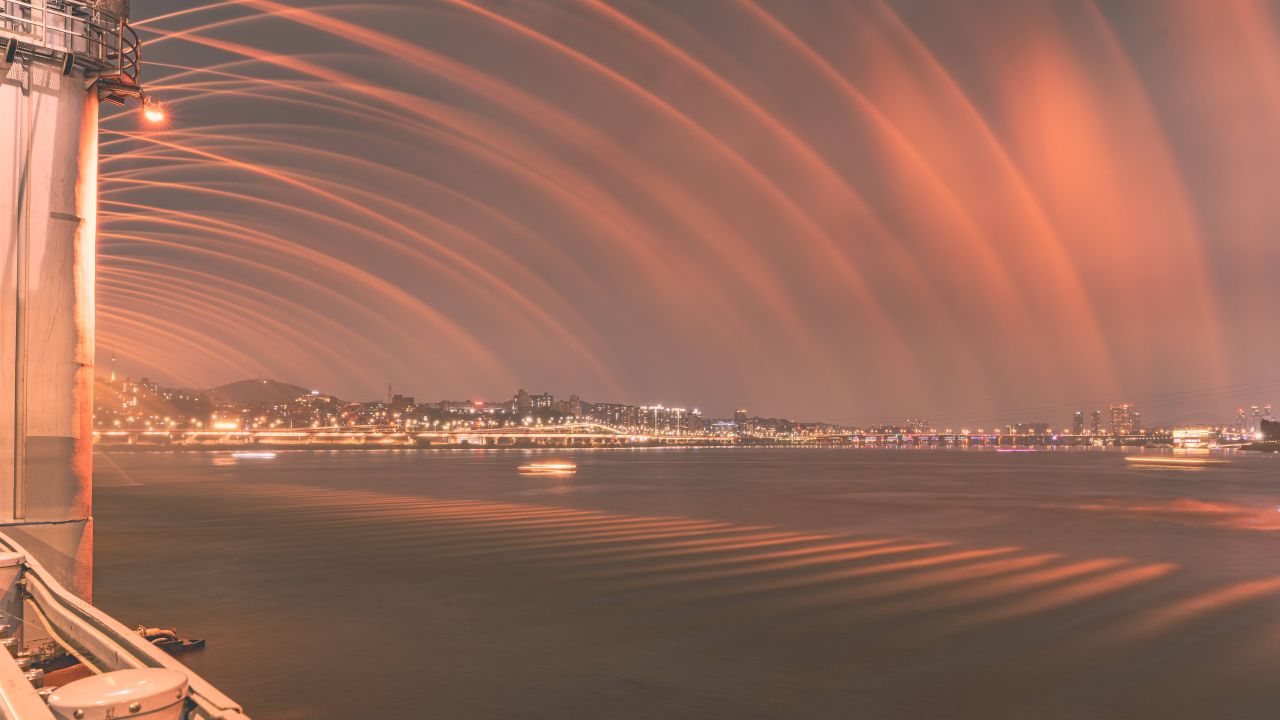
- What you will see: Water jets launching up to 20 meters into the river, lit by roughly 200 lights that cycle through rainbow colors in time with a music track, visible from either the bridge itself or the riverside park below.
- Getting there: The fastest approach is Express Bus Terminal Station on Line 3, 7, or 9 — take Exit 8-1 or 8-2 and follow the walk down toward the river; Dongjak Station on Line 4, Exit 1, works as a quieter alternative along the riverside path.
- Tickets and admission: Free — no ticket, reservation, or entry gate of any kind.
- Tips from past visitors: People who arrive expecting to walk straight up and watch often end up boxed out; those who stake a spot near the bridge or on the lower Jamsu Bridge level 20–30 minutes ahead tend to get both a clear view and better sound.
- Nearby spots worth combining: Some Sevit’s floating pavilions sit just off the south end of the bridge and pair naturally with a fountain visit, and the wider Banpo Hangang Park gives you room to picnic before or after the show.

What Time Does the Banpo Rainbow Fountain Show Start?
The Banpo Rainbow Fountain runs on a fixed daily schedule that shifts only with the calendar, not day to day, so once you know the season you know the exact times. From April through June and again in September and October, shows go at 12:00 PM, 7:30 PM, 8:00 PM, 8:30 PM, and 9:00 PM. In July and August, an extra late show is added at 9:30 PM to take advantage of longer daylight and warmer nights. Each show lasts about 20 minutes, which is enough time to catch two or three full musical cycles if you stay put.
My read on the schedule: the noon show is a curiosity — daylight washes out the colored lighting, so you mostly see the water arcs and none of the rainbow effect. If you’re choosing one show to prioritize, make it the first evening slot. It draws a lighter crowd than the later ones since dinner-hour visitors haven’t arrived yet, and you still get the full lighting effect once the sky darkens partway through. The 8:00 and 8:30 PM slots are consistently the most crowded because they land in that sweet spot after sunset when the colors read most vividly against a dark sky.
The fountain does not operate from November through March 15. If you’re planning a trip in that window, this specific attraction simply won’t be running regardless of what listings say — build your Han River evening around Some Sevit or a river cruise instead.
Is the fountain running today?
Because shows depend on river conditions and weather, the printed schedule is a plan, not a guarantee. Heavy rain, wind over roughly 7 m/s, or a river running high and muddy after storms will cancel that day’s shows with little advance warning posted on-site. If you’re making a special trip and the forecast looks rough, calling the Korea Travel Hotline (1330) before you leave saves a wasted evening — the operators can confirm same-day cancellations faster than checking social media.
How to Get to Banpo Hangang Park by Subway and Bus
The most reliable way to reach the Banpo Rainbow Fountain is Express Bus Terminal Station, served by three subway lines, followed by a 15–20 minute walk. Take Line 3, 7, or 9 to Express Bus Terminal Station, exit via 8-1 or 8-2, walk straight for about 250 meters, turn right at the main intersection, continue another 400 meters, and pass through the pedestrian underpass to reach the park. It’s a flat, well-lit walk, but it’s longer than most first-timers expect — treat it as a 20-minute buffer, not a 5-minute stroll.
If Exit 8’s crowd feels like too much, especially on weekend evenings, Dongjak Station offers a calmer alternative. From Dongjak Station on Line 4, take Exit 1, walk about 20 meters, turn left onto the riverside pedestrian path, and follow it roughly 900 meters east to the park. This route runs directly along the water, so you get a preview of the river before the fountain even comes into view — my pick if you want a slower, less crowded arrival.
By bus, city buses 405 and 8340 stop directly at Banpo Hangang Park, and 740 and 143 also serve the area. Buses are a reasonable option if you’re coming from a neighborhood without a direct subway connection, but during evening rush hour they can get stuck in the same traffic backing up onto the bridge approaches — the subway plus walk is usually faster and more predictable.
One route worth knowing if you’re coming from the Gangnam side: ride Line 3 to Jamwon Station, then walk along the water toward Banpo Bridge and exit near Express Bus Terminal Station. It adds a bit of distance but keeps you next to the river the whole way, which makes the walk feel shorter than it is.
Where to Stand for the Best View of the Rainbow Fountain
The single biggest factor in how good your view is has nothing to do with the show itself — it’s whether you claim a spot early. The area right along the riverbank in Banpo Hangang Park fills in fast on Saturdays especially — Korea Tourism Organization crowd data marks Saturday as the peak day and Tuesday as the quietest, and that pattern matches what you’ll notice on the ground: a Tuesday visit means you can walk up ten minutes before a show and still get a clean sightline, while a Saturday visit means the good spots are gone well before sunset.
For the closest, most immersive experience, get onto Jamsu Bridge itself, ideally on the lower level. Standing near the bridge puts you close enough to hear the music clearly and feel the spray on a warm night — the effect is noticeably more immersive than watching from the park’s grassy bank a few hundred meters back. The tradeoff is that this spot fills up fastest, and once the railing is lined with people it’s hard to reposition mid-show.
If photography matters more than proximity, the park side gives you the wider frame you need to fit the full fountain, the bridge lights, and the skyline in one shot. Walking a short distance west along the riverbank opens up angles where the fountain, the water reflection, and city lights line up without a crowd cutting across your foreground. Arrive for the blue hour — the 20–30 minutes right after sunset when the sky still holds a deep blue tone but the fountain lights have already switched on — for the shots that actually look different from a phone snapshot taken in full darkness. That window shifts with the season, so if you’re chasing it for a specific show, plan to be in position at least 40 minutes before showtime rather than relying on a fixed clock time.
Solo travelers asking where to combine the fountain with a Han River sunset should walk westward along the bank before the show starts. The sightline west is unobstructed by the bridge structure, so you get the sunset first and then simply turn around as the fountain lights come up — no need to relocate between the two.
Chimaek, Picnics, and the Han River Evening Ritual
Watching the fountain with a spread of fried chicken and beer on a picnic mat is close to a local rite of passage, not a tourist gimmick — it’s how a large share of regular visitors actually experience the park on a warm evening. Convenience stores inside Banpo Hangang Park sell the basics (mats, drinks, snacks, and simple instant noodles you can prepare at the riverside cooking stations), so you don’t need to carry much from outside. If you want the full chimaek experience, ordering ahead from a delivery app for pickup or delivery to a numbered picnic zone is common practice among regulars, though timing it to arrive before a show gets crowded takes some slack in your schedule.
The atmosphere shifts noticeably through the evening. Late afternoon is quiet — joggers, cyclists, a scattering of picnic mats. By the time the first evening show approaches, the grass fills with groups staking out territory, portable speakers and the smell of grilling meat drifting across the park. After the final show, a good portion of the crowd lingers rather than rushing out, which means the walk back to the subway is far less congested than the walk in.
On Sundays, Jamsu Bridge itself becomes part of the experience beyond the fountain — the bridge periodically closes to vehicle traffic for a car-free festival, opening the road deck to pedestrians, performers, and pop-up activities. If your visit lands on a Sunday, checking whether the car-free event is running that week is worth the extra step, since it changes both the crowd flow and where you can physically stand on the bridge during a show.
Combining the Visit with Some Sevit and a Han River Cruise
Pairing the Banpo Rainbow Fountain with Some Sevit’s floating pavilions makes for a natural two-stop evening since the islands sit just off the bridge’s southern end within easy walking distance. Some Sevit (map) is built around three artificial islands designed around the theme of a flower blooming across its life stages, and the largest island functions as a multi-purpose venue for performances and exhibitions. Even without going inside a specific facility, walking around the islands’ perimeter before or after a fountain show gives you a different angle on the same stretch of river — the lit-up pavilions make a striking foreground against the fountain and bridge lights.
For a view most visitors never consider, a Han River cruise lets you watch the fountain from the water itself rather than the bank. Seeing the jets erupt on both sides of the bridge simultaneously, framed by the skyline behind them, is a genuinely different composition than anything you’ll get standing on land — it’s the option to weigh if you’ve already seen the fountain from the bridge and park on a previous trip and want a fresh angle.
Common Mistakes First-Time Visitors Make
Showing up right at the listed showtime is the single most common misstep, and it fails for a structural reason: the good viewing spots along the bridge railing and riverbank fill up 20–40 minutes before a show starts, especially on weekends, so arriving on time means you’re choosing between a distant view or craning over someone’s shoulder. Build in a buffer and treat the listed time as when the water starts moving, not when you should arrive.
Assuming the rainbow lights on Banpo Bridge run continuously is another frequent misunderstanding — they don’t. The colored lighting is tied specifically to the scheduled shows; outside those windows, the bridge is lit with standard architectural lighting, not the rainbow fountain effect. If you show up between scheduled times expecting to catch the display, you’ll see a normally-lit bridge and wonder if you’re in the wrong place.
Visiting during winter is a mistake rooted in incomplete research: the fountain does not operate from November through March 15, full stop, regardless of what an outdated blog post or cached listing might suggest. Always cross-check the current year’s season dates before building a winter Seoul itinerary around this stop.
Underestimating the walk from Express Bus Terminal Station trips up a lot of visitors carrying picnic supplies or traveling with kids. The 15–20 minute walk includes a pedestrian underpass and a couple of turns that aren’t obvious from a subway map alone, so first-timers often budget five minutes and end up rushing or arriving after a show has already started.
Finally, not having a backup plan for a weather cancellation costs people an entire evening. Because cancellations tied to wind, rain, or river conditions can happen with little posted warning, checking the forecast or calling the 1330 hotline before committing to the trip protects you from a wasted subway ride, particularly if the fountain is the single reason for your visit that night.
Frequently Asked Questions
Is the Banpo Rainbow Fountain free to watch?
Yes, watching the fountain show is completely free with no ticket or reservation required. Anyone can walk along Banpo Hangang Park or Jamsu Bridge during a scheduled show time and watch at no cost.
Are the rainbow lights on Banpo Bridge on all the time?
No, the colored rainbow lighting is only active during the scheduled fountain shows. Outside show times, the bridge uses standard lighting, so the rainbow effect you see in photos is specific to the roughly 20-minute performance windows.
What happens if the show is canceled due to weather?
Shows can be canceled without much advance notice if there’s heavy rain, wind exceeding about 7 m/s, or high, muddy river water. Checking the forecast beforehand or calling the Korea Travel Hotline (1330) is the most reliable way to confirm whether a show is running before you make the trip.
Which subway exit is closest to the Banpo Rainbow Fountain?
Express Bus Terminal Station, served by Lines 3, 7, and 9, is closest — use Exit 8-1 or 8-2 and follow the roughly 15–20 minute walk through the pedestrian underpass to the park. Dongjak Station on Line 4, Exit 1, offers a quieter riverside walking route as an alternative.
Are attractions near Banpo Bridge open during holidays like Chuseok?
Hours and operating schedules for facilities near the river, including any seasonal markets, can change during Korean public holidays, so it’s worth confirming current status through the official Hangang park notices before visiting on a holiday. The fountain’s own seasonal schedule isn’t holiday-dependent, but surrounding vendors and facilities may adjust their hours.
In Conclusion
Getting the most out of the Banpo Rainbow Fountain comes down to timing your arrival, not just knowing the showtime. Aim for Express Bus Terminal Station’s Exit 8-1 or 8-2, budget the full 15–20 minute walk, and plant yourself along the bridge or riverbank at least 20–30 minutes before whichever evening slot you’re targeting — the first evening show tends to offer the best balance of full lighting and manageable crowds. Bring a mat and something to eat if you want the full riverside picnic experience, keep an eye on the weather given the cancellation risk, and consider folding in Some Sevit or a Sunday car-free bridge walk if your schedule allows. Show up prepared and you’ll spend the evening watching water and lights instead of someone else’s back.
Discover more from Korea Visiting
Subscribe to get the latest posts sent to your email.