Putting together a Changgyeonggung Palace guide before you land in Seoul usually starts with one confusing question: how is this palace different from Changdeokgung, the palace right next door? If you’ve been scrolling through palace photos and can’t tell which gate leads where, you’re not alone — first-time visitors regularly walk into the wrong palace expecting a greenhouse. The good news is that once you know the layout, Changgyeonggung is actually one of the easier palaces to plan around: it’s smaller, quieter, and built around a genuinely unusual attraction — an early-1900s glass greenhouse — instead of a sprawling garden that requires advance booking.
Key Takeaways
- Changgyeonggung and Changdeokgung are two separate but internally connected palaces — Changgyeonggung is known for its Grand Greenhouse, while Changdeokgung has its own distinct garden grounds.
- Adult admission is about 1,000 KRW, with free entry for anyone wearing hanbok, seniors 65+, and children 6 and under.
- The nearest subway stop is Hyehwa Station (Line 4, Exit 4), roughly a 10–15 minute walk.
- The Moonlight Lotus Show, a night media-art program at Chundangji Pond, runs on a seasonal schedule with no extra reservation needed beyond regular admission.
- Because it’s smaller and less visited than Gyeongbokgung, Changgyeonggung can realistically be paired with Changdeokgung or Jongmyo in a single day.
📍 Changgyeonggung Palace — Essential Information
| Address | 185 Changgyeonggung-ro, Jongno-gu, Seoul |
| Opening hours | 09:00-21:00 (Last admission 20:00) |
| Closed | Mondays * Closed the next business day if Monday is a holiday |
| Parking | Available (22 parking spaces) |
| Website | royal.khs.go.kr |
| Map | Google Maps · Naver Map |
Changgyeonggung Palace at a Glance
- Why visit: Changgyeonggung trades the grand state-affairs scale of Gyeongbokgung for something more intimate — a former royal residence with a genuinely unusual centerpiece, an early-1900s Western-style glass greenhouse.
- What you’ll see: The stone Myeongjeongjeon throne hall, the arched Okcheongyo Bridge, the pond and lotus flowers at Chundangji, and the Grand Greenhouse (Daeonsil) with its cast-iron frame and seasonal plantings.
- Getting there: Most visitors walk in from Hyehwa Station on Line 4 (about 10–15 minutes) or from Anguk Station on Line 3 (closer to 19 minutes); a short bus ride from Anguk shaves off some of that walk.
- Tickets: Adult admission runs about 1,000 KRW, with discounts for groups and teens, and free entry for seniors, young children, and anyone in hanbok.
- Tips from past visitors: Go early on weekday mornings for quieter paths, and wear hanbok if you’re doing a palace-hopping day — it waives the entry fee at every stop, not just this one.
- Nearby spots worth combining: Changdeokgung is directly connected on foot, and Jongmyo Shrine sits a short walk away, making this a natural three-stop cluster for a single afternoon.

A Quick Changgyeonggung Palace Guide to Tickets and Admission Fees
A Changgyeonggung Palace guide isn’t complete without knowing exactly what you’ll pay at the gate, and the answer is refreshingly simple: adult admission (ages 19–64) is about 1,000 KRW, group tickets (10 or more people) run 800 KRW per person, and teens and children aged 7–18 pay 500 KRW. Children 6 and under and visitors 65 and older get in free, and — this is the detail most first-timers miss — anyone wearing hanbok also enters for free, which is why you’ll see so many rental-hanbok groups posing near Myeongjeongjeon.
If your itinerary includes multiple palaces, the Royal Palace Pass is worth considering: for 10,000 KRW it covers admission to five royal heritage sites, including Changgyeonggung, and stays valid for three months, which works well if you’re spreading your palace visits across a longer Seoul trip rather than cramming them into one day. Culture Day — every Wednesday — also waives admission entirely at Changgyeonggung and most other public heritage sites, so it’s worth checking the calendar before you go. One note for planning ahead: admission fees at Korea’s royal palaces are expected to rise starting January 2027, so the prices above reflect the current rate as of 2026.
Getting to Changgyeonggung Palace by Subway and Bus
The most reliable way to reach Changgyeonggung is Hyehwa Station on Line 4, exiting from Exit 4 and walking roughly 10–15 minutes north toward the palace’s main entrance — flat, straightforward, and easy to follow even without much Korean. Anguk Station on Line 3, Exit 3, is the other common option, though it’s a longer walk at around 19 minutes; if you’d rather not walk the whole way, head to Exit 6 instead, find bus stop #01200, and catch bus 272, 151, 171, or 172 for a two-stop ride, then cross the street to the entrance.
Coming from Seoul Station, the fastest route is Line 1 to Jongno 3-ga Station, about five minutes, followed by a short transfer or walk toward the palace area; Line 4 straight to Hyehwa takes 11 minutes but drops you nearer the main gate. If you’re already exploring Jongno-3-ga’s snack alleys or the Bukchon area, factor in that Changgyeonggung sits at the quieter, less-touristed edge of this cluster, so allow a little extra walking time compared to hopping between Gyeongbokgung and Bukchon Hanok Village.
Inside the Grand Greenhouse (Daeonsil)
The Grand Greenhouse, or Daeonsil, is the single most photographed spot in the palace and the reason many visitors add Changgyeonggung to their itinerary in the first place. Built in the early 1900s, it’s widely described as Korea’s first Western-style greenhouse, and its cast-iron and glass structure feels genuinely out of step with the rest of the traditional wooden palace grounds — which is exactly what makes it memorable. Inside, the layout rotates seasonal plants and includes camellias, orchids, and citrus trees, with light filtering through the old glass panes in a way that photographs beautifully in both directions, looking in from the garden and looking out from inside.
Because the greenhouse is compact, it fills up quickly with tour groups and hanbok-clad visitors mid-morning through early afternoon, so if getting a clear shot of the structure matters to you, arriving close to opening or visiting later in the afternoon on a weekday gives you noticeably more breathing room. The surrounding garden, with its symmetrical flower beds and low hedges, is worth a slow loop on its own — it’s one of the few spots in the palace that feels more like a European-style garden than a Joseon-era courtyard, a deliberate design choice from when the site was reworked during the Japanese colonial period.
Chundangji Pond and the Moonlight Lotus Show
Chundangji Pond is the palace’s other signature view, a long, willow-lined pond just past the greenhouse that’s especially striking with lotus blooms in summer and reflected foliage in autumn. During the day it’s a peaceful spot to sit and slow down after the more structured formal courtyards near the entrance, and it’s consistently one of the most photographed corners of the palace on social media.
At night, Chundangji becomes the stage for the Moonlight Lotus Show, a media-art program that projects light and imagery onto the pond and surrounding trees, running regularly since March 2025. The schedule shifts through the year: full-scale screenings at both the large and small ponds happen during spring (April 15–May 18, 20:00–21:00) and autumn (September 10–November 8, 19:00–21:00), while partial screenings run during the remaining months at slightly different hours. The appealing part for planning purposes is that you don’t need a separate reservation — regular palace admission (about 1,000 KRW) covers it, which makes it one of the more accessible night experiences among Seoul’s royal palaces. If your trip dates overlap with either full-screening window, it’s worth timing your visit for evening rather than daytime to see the pond at its most atmospheric.
Myeongjeongjeon Hall and Okcheongyo Bridge: The Historic Core
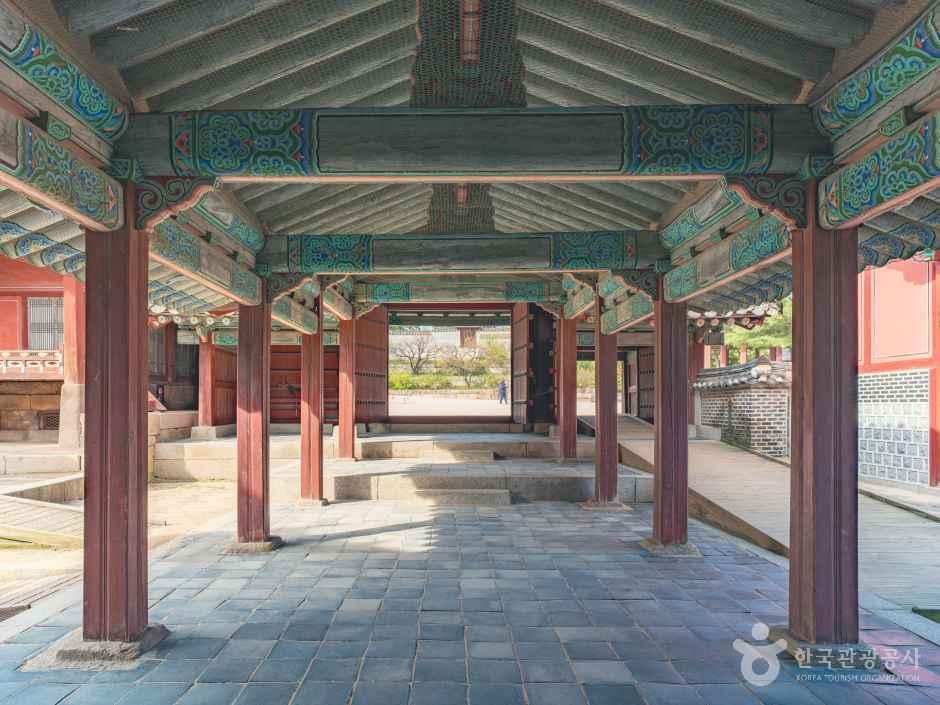
Myeongjeongjeon, the palace’s main throne hall, is the formal heart of Changgyeonggung and one of the oldest surviving throne halls among Korea’s royal palaces — its stone courtyard and modest scale make a useful contrast if you’ve already seen Gyeongbokgung’s much larger Geunjeongjeon. Just past the main gate, Okcheongyo Bridge, a stone arch bridge over a small stream, marks the traditional threshold visitors crossed before entering the palace proper, and its carved details are worth a slower look rather than a quick walk-through.
Compared to Changdeokgung or Gyeongbokgung, the halls here feel noticeably more restrained — smaller footprints, quieter courtyards, fewer crowds funneling through at once — which lines up with the palace’s original purpose as a residence for queens, queen dowagers, and concubines rather than a stage for state ceremonies. That history is worth keeping in mind as you walk through: you’re moving through what was essentially the domestic and residential side of the Joseon court, not the administrative one, and the architecture reflects that lower-key, more livable scale throughout.
Why Changgyeonggung Faces East-West: A Palace Built for Queens
Most Joseon palaces, including Gyeongbokgung and Changdeokgung, are laid out on a north-south axis, but Changgyeonggung is oriented east-west — an unusual choice that traces back to its original 15th-century construction as Suganggung Palace, built by King Sejong for his retired father, King Taejong. When King Seongjong renovated and renamed it Changgyeonggung in the late 1400s, it kept this residential character, functioning largely as living quarters for the palace’s women rather than a venue for major state affairs.
That backstory explains a lot about how the palace feels today: the buildings are more human-scaled, the pathways wind rather than march in straight formal lines, and the overall atmosphere leans toward domestic rather than ceremonial. It’s a detail worth mentioning if you’re visiting with someone who’s already toured Gyeongbokgung and finds Changgyeonggung underwhelming at first glance — the point isn’t scale, it’s a different kind of history entirely, one centered on the people who actually lived here day to day rather than the kings who ruled from elsewhere on the grounds.
Combining Changgyeonggung with Changdeokgung and Jongmyo
Changgyeonggung connects directly to Changdeokgung Palace by an internal walking path, which is the single most useful planning fact for anyone trying to see both in one day — you don’t need to exit and re-enter through separate main gates. That said, pace yourself: Changdeokgung has its own separate sights worth allotting real time to, and visitors who try to squeeze a full tour of both palaces into a few hours often end up rushing one or the other. Build your Changgyeonggung visit around a realistic timeline so you’re not racing the clock at either site.
Jongmyo Shrine, the Joseon royal ancestral shrine, is another short walk from this cluster and pairs naturally with a Changgyeonggung visit if you have a full day free — note that the direct northern gate connecting Jongmyo and Changgyeonggung only opens on weekends and special days, so on weekdays you’ll need to walk around via the street. Free English-language guided tours are offered at several of these sites, but timings vary, so checking the schedule at the entrance or online before you commit to a route saves you from waiting around for a tour that’s already left.
Where to Eat Near Changgyeonggung Palace
The streets around this palace cluster are dense with small, specific places rather than big restaurant rows, so it helps to know a few names in advance instead of wandering. Near Jongno 3-ga, a snack alley is popular for quick bites between palace stops — look for busy stalls doing Busan-style fish cakes and rice tteokbokki, and a ramen-and-kimbap combo shop that’s become a favorite with foreign visitors for its simple, filling set. Near the Jongmyo entrance, a small traditional tea house serves handmade herbal teas, including a raw kudzu juice that’s bitter up front with a sweet finish — a good stop if you want something other than coffee after a long walk.
On the Changdeokgung side, the alley known as Seosullat-gil has become a hotspot for a younger crowd, with a taco spot known for long lines (ordering downstairs and eating upstairs on the rooftop is a known workaround), a mushroom cream pasta spot in the same building, and a couple of hanok-style dessert cafés for a slower break. If you’d rather sit down properly, a few small restaurants near Changdeokgung offer palace-view seating for brunch or a short course meal — reservations are strongly recommended since seating is limited, and window tables tend to go first.
Photography Tips for the Greenhouse and Chundangji Pond
The Grand Greenhouse photographs best in the late afternoon, when low sunlight comes in sideways through the glass panels and throws long shadows across the garden beds outside — midday sun tends to flatten the structure and wash out the glass reflections. If you’re shooting from inside looking out, position yourself near the central aisle where the iron framework lines up symmetrically; it’s a small adjustment that makes a noticeable difference in the final shot.
At Chundangji Pond, spring cherry blossom season and autumn foliage are the two clear standout windows, with the water creating mirror reflections on calm mornings before the crowds arrive. If your trip lines up with the Moonlight Lotus Show’s full-screening dates, arrive at the pond right at opening for the night program to claim a spot along the water’s edge — the sightlines fill in quickly once the projections start, and latecomers end up shooting over other visitors’ shoulders.
Frequently Asked Questions
Is Changgyeonggung Palace worth visiting compared to other palaces?
Yes, especially if you’ve already seen Gyeongbokgung or plan to — Changgyeonggung offers a quieter, more residential contrast with a genuinely unique attraction in the Grand Greenhouse. It’s smaller in scale, which some visitors find less impressive at first, but its history as a queens’ residence and its east-west layout give it a distinct character rather than repeating what you’ve already seen elsewhere.
How much time should I allow for a visit?
Most visitors comfortably cover the main halls, Chundangji Pond, and the Grand Greenhouse in about 1.5 to 2 hours at a relaxed pace. Add extra time if you’re visiting during a full Moonlight Lotus Show screening window, since staying for the evening program effectively turns it into two separate visits within one admission.
Can I combine Changgyeonggung with Changdeokgung in one day?
Yes, and it’s one of the most common combinations since the two palaces are connected by an internal walking path. Just allow enough time for both palaces, since Changdeokgung has its own separate sights that deserve unhurried exploration.
Are free guided tours available at Changgyeonggung?
Free English-language guided tours are offered at Changgyeonggung and nearby palaces, though timings vary by day and season. Check the schedule posted at the entrance or the official site before your visit so you don’t miss the departure time.
Does wearing hanbok get me free entry?
Yes — visitors wearing hanbok receive free admission to Changgyeonggung, along with most other royal palaces in Seoul. It’s one of the most practical tips for a palace-hopping day, since it removes the ticket line entirely at each stop.
In Conclusion
Changgyeonggung rewards visitors who treat it as its own destination rather than a smaller stand-in for Gyeongbokgung — the Grand Greenhouse, the quieter courtyards, and the Moonlight Lotus Show at Chundangji Pond give it a character none of the other palaces quite match. Get there via Hyehwa Station, budget around 1,000 KRW for admission (or skip the fee entirely in hanbok), and build in time to walk the internal path over to Changdeokgung if your schedule allows. Whether you’re chasing a specific photo at the greenhouse or just want a calmer palace experience than the big-name sites offer, arriving early on a weekday and pairing your visit with a nearby meal in Jongno-3-ga or Bukchon turns this into one of the easiest, least stressful stops on a Seoul palace itinerary.
Discover more from Korea Visiting
Subscribe to get the latest posts sent to your email.