Arriving at Gyeongbokgung Palace for the first time, most visitors feel the same low-grade anxiety: which gate is the real entrance, is today one of the days it’s actually open, and is two hours enough or will you need the whole afternoon? The palace grounds are enormous, the signage inside doesn’t explain everything, and a rushed visit tends to end with tired feet and a phone full of photos you can’t identify. This Gyeongbokgung Palace guide is built around the questions people actually search before they go — ticket prices, the free-entry rules everyone forgets, how the Royal Guard Ceremony timing works, and which corners of the palace are worth slowing down for versus which ones you can walk past. Get the logistics settled before you arrive and the visit turns from a maze into an easy half-day (or full day) out.
Key Takeaways
- Adult admission is 3,000 KRW, but wearing a full hanbok gets you in free — and it’s the single most popular money-saving tip among visitors.
- The palace closes every Tuesday; if a public holiday lands on Tuesday, it stays open and closes the following weekday instead.
- The Changing of the Royal Guard Ceremony runs at Gwanghwamun Gate at 10:00 AM and 2:00 PM daily except Tuesdays — arrive 10 minutes early for a clear view.
- Budget 1.5–2 hours for a focused walk-through, or 3–5 hours if you’re wearing a hanbok, photographing, or pairing it with the on-site museums.
- Gyeongbokgung Station (Line 3, Exit 5) is the fastest way in, putting you a 2–3 minute walk from the main gate.
📍 Gyeongbokgung Palace — Essential Information
| Address | 161 Sajik-ro, Jongno-gu, Seoul |
| Opening hours | November-February 09:00-17:00 (Last admission 16:00) March-May & September-October 09:00-18:00 (Last admission 17:00) June-August 09:00-18:30 (Last admission 17:30) |
| Closed | Tuesdays (If Tuesday falls on a public holiday, it will be closed on the following business day instead) |
| Parking | Available |
| Website | royal.khs.go.kr |
| Best time to visit | Least crowded on Wednesdays; busiest on Saturdays (Korea Tourism Organization crowd forecast) |
| Map | Google Maps · Naver Map |

Gyeongbokgung Palace at a Glance
Why visit: it’s the largest and most architecturally striking of Seoul’s five Joseon-era palaces, and the easiest one to reach from downtown, which is why it’s usually the first royal site on a first-time visitor’s list.
What you’ll see and experience: sweeping stone courtyards, the throne hall of Geunjeongjeon, the lake pavilion of Gyeonghoeru, quieter garden corners like Hyangwonjeong Pavilion, and — if you time it right — the uniformed Royal Guard marching past Gwanghwamun Gate.
Getting there: Gyeongbokgung Station (Line 3, Exit 5) puts you at the palace’s front gate in about 2–3 minutes on foot; Gwanghwamun Station (Line 5, Exit 2) is a slightly longer 7–8 minute walk but works well if you’re coming from the Gwanghwamun Square side.
Tickets and admission: adults pay 3,000 KRW, while admission is free for visitors aged 18 and under (Korean nationals up to age 24), seniors 65+, and anyone wearing a full hanbok; the palace is also free to everyone on the last Wednesday of each month. Bring a passport or ID if you’re claiming free entry.
Tips from past visitors: come before 9 AM for empty courtyards and soft morning light, and don’t skip Hyangwonjeong Pavilion — most crowds never make it that far in.
Nearby spots worth combining: Bukchon Hanok Village, the National Palace Museum of Korea, and the National Folk Museum of Korea all sit within a short walk of the palace grounds.
How to Get to Gyeongbokgung Palace
The fastest route into Gyeongbokgung Palace is by subway, and getting the exit right saves you a needless loop around the outer wall. Take Line 3 to Gyeongbokgung Station and use Exit 5 — it feeds directly onto Sajik-ro and puts you within a two- to three-minute walk of the main entrance, making it the route nearly every guide and local recommends. If you’re coming from the Gwanghwamun Square or City Hall area instead, Line 5’s Gwanghwamun Station, Exit 2, works nearly as well, adding only about five extra minutes of walking along a pleasant tree-lined stretch that passes the statue plazas before reaching the palace’s Gwanghwamun front gate.
Bus is a solid backup if your accommodation isn’t near a Line 3 or Line 5 stop. Several routes stop right by the palace or the adjacent National Palace Museum of Korea, including green buses 1020 and 7025 and blue buses 109, 171, 172, 601, and 606. Because Seoul’s palace district sits inside a low-traffic historic zone, taxis can get stuck circling for a drop-off point during peak hours, so the subway remains the least stressful option, especially if you’re already dressed in a hanbok and don’t want to be walking far in it.
Gyeongbokgung Palace Tickets, Admission Fees and Free Entry
Gyeongbokgung Palace admission is inexpensive on its own and, for a large share of visitors, free entirely once the hanbok discount is factored in. Standard adult tickets cost 3,000 KRW. Visitors aged 18 and under (Korean nationals up to age 24, with a passport or ID), seniors aged 65 and over, and anyone visiting in a complete hanbok all enter at no charge — the hanbok rule is the one most first-timers don’t realize applies to them, and it’s the reason so many visitors rent an outfit for the day rather than paying the ticket price.
If you’re planning to see more than one palace, the combination ticket is worth knowing about: 10,000 KRW for adults covers entry to four palaces (Gyeongbokgung, Changdeokgung, Changgyeonggung, and Deoksugung) plus Jongmyo Shrine, and it stays valid for three months. For budget travelers, the palace is also completely free to everyone, hanbok or not, on the last Wednesday of every month as part of the city’s “Culture Day” program — a detail worth building a trip around if your dates are flexible.
Best Time to Visit Gyeongbokgung Palace
The best time to visit Gyeongbokgung Palace is early morning on a weekday, ideally right after opening, when the courtyards are still empty and the light is softest for photos. According to Korea Tourism Organization crowd data, Wednesdays tend to be the least crowded day at the palace, while Saturdays are consistently the busiest — worth factoring in if your itinerary has any flexibility.
Seasonally, spring (roughly March–May) and autumn (September–October) draw the biggest crowds because of cherry blossoms and fall foliage against the palace’s traditional rooflines, but they’re also genuinely the most rewarding months to shoot photos, hanbok or not. Summer brings extended evening hours but also heat and humidity that make heavy hanbok fabric uncomfortable by midday, so an early start or a late afternoon visit works better. Winter is the quietest season overall and gives you the closest thing to a crowd-free palace, though shorter daylight hours mean less time to explore before closing. Whatever the season, arriving within the first hour of opening consistently beats arriving any time after mid-morning, once tour groups and school trips start filling the main courtyard.
Things to See Inside Gyeongbokgung Palace
Geunjeongjeon, the throne hall at the heart of the complex, is the building most visitors photograph first, and it’s worth pausing at its stone courtyard to notice the ranking markers that once told court officials exactly where to stand during ceremonies. Just beyond it, Gyeonghoeru Pavilion sits on a rectangular pond and was historically used for royal banquets — it’s especially striking in the late afternoon when the reflection on the water doubles the building’s scale.
For a quieter experience, head toward Hyangwonjeong Pavilion in the palace’s northern gardens. Built on a small artificial island and reached by a wooden footbridge, it draws far fewer visitors than the main halls simply because it requires an extra ten-minute walk — which is exactly why past visitors recommend it as the spot to actually slow down and enjoy the palace without a crowd in every photo. Nearby, within the same northern section, is the site associated with the creation of Hangeul, the Korean alphabet, developed under King Sejong — a detail most visitors walk straight past without realizing its significance.
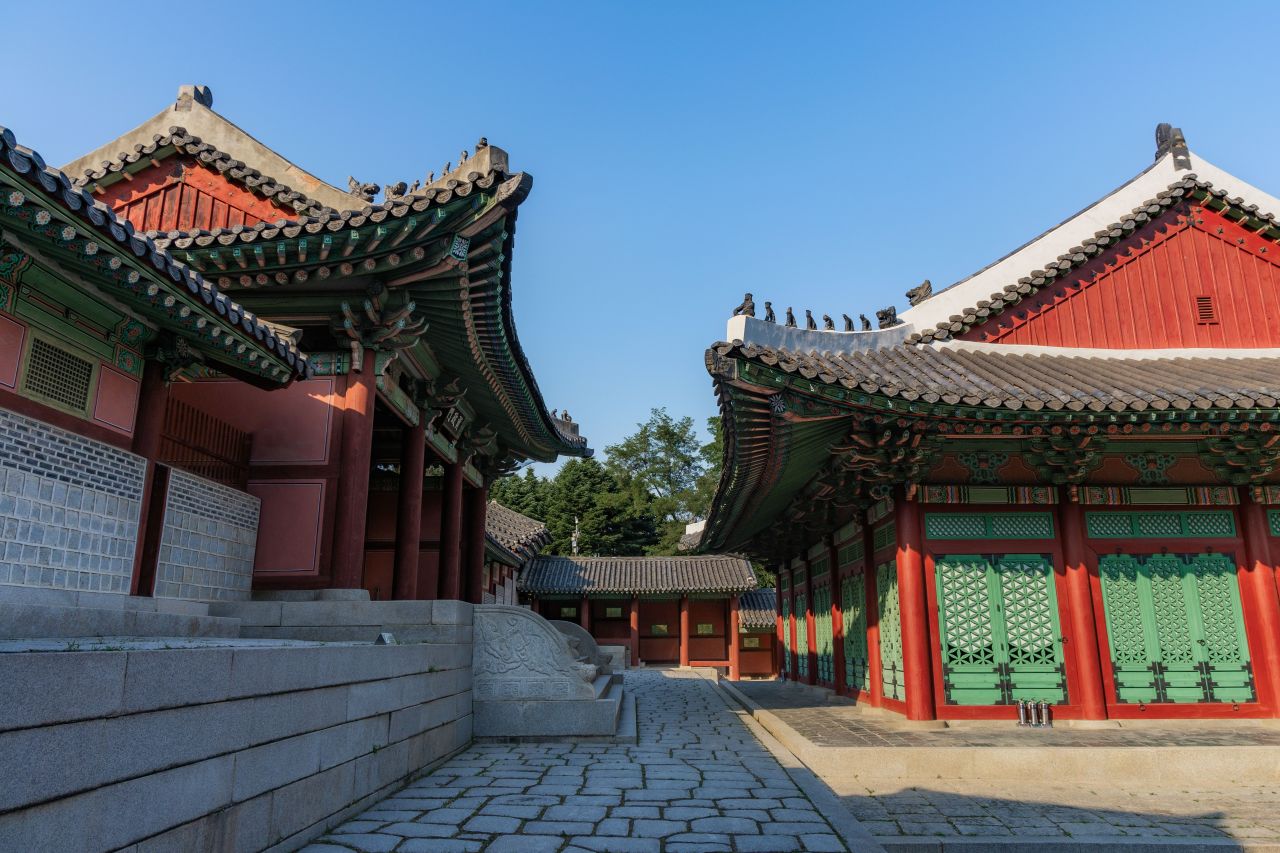
Look up as you move between buildings and you’ll notice small figures lined up along the curved rooflines. These are japsang, guardian figures believed to ward off evil spirits and fire, and the number and arrangement of them actually signals a building’s importance — Geunjeongjeon has the most of any hall in the complex. It’s a small detail, but noticing it turns a simple walk-through into something closer to reading the architecture.
Watching the Royal Guard Changing Ceremony at Gwanghwamun
The Changing of the Royal Guard Ceremony takes place at Gwanghwamun, the palace’s main gate, daily except Tuesdays, at 10:00 AM and 2:00 PM, with each performance running about 20 minutes. Guards in reconstructed Joseon-era uniforms carry out the changeover with drums, flags, and traditional music, and it’s one of the few free cultural performances in Seoul that doesn’t require booking ahead.
Arrive at least ten minutes before either showtime to get a clear sightline — the space in front of the gate fills in fast, especially for the 2 PM slot when day-trip crowds peak. Positioning yourself slightly off to one side rather than directly in the center usually gives a better angle for photos, since the main crowd bunches up right in front of the gate. If your schedule only allows one ceremony, the 10 AM performance tends to be less crowded than the afternoon one, particularly in spring and autumn.
Wearing a Hanbok at Gyeongbokgung Palace
Wearing a hanbok inside Gyeongbokgung Palace gets you free admission and, more importantly, changes how the visit feels — the palace’s architecture was built to be seen alongside traditional dress, and photos taken in hanbok against the courtyards look noticeably different from ordinary tourist shots. Rental shops cluster around the palace’s main entrance and along the streets toward Bukchon, offering everything from simple modern-cut hanbok to more elaborate historical styles; brighter colors and floral patterns tend to photograph better in daylight against the palace’s grey stone and red-brown wood, while deeper jewel tones stand out well in the shade of the covered walkways.
A few practical points make the experience smoother. Backpacks and puffer jackets break the visual line of a hanbok, so most shops offer a small drawstring bag as an alternative, and it’s worth using it if photos matter to you. In hot months, choose a lighter fabric option if the shop offers one — full hanbok in summer heat is the most common complaint from first-time wearers. For photos, resist the urge to stand stiffly with hands at your sides; a slight turn toward the camera, one hand lightly holding the skirt or gathering a sleeve, reads far more natural in photos than a straight-on pose. The quieter garden areas near Hyangwonjeong Pavilion, away from the main courtyard crowds, tend to give the best combination of scenery and breathing room for a proper photo session.
Gyeongbokgung at Night: Night Openings and the Starlight Tour
Two after-dark programs run for limited periods each year, usually in spring and autumn, and both need tickets booked in advance:
- Night opening (야간관람): the main halls and Gyeonghoeru Pavilion are lit up and open in the evening. Tickets are sold online ahead of each season, and popular dates go quickly, so note the release date.
- Starlight Tour (별빛야행): a guided small-group program that includes a traditional meal and a walk through areas normally closed to visitors. Capacity is small, so it is harder to book than the night opening.
Dates change every year, so check the Royal Palaces and Tombs Center website before planning around them. Evenings get cold quickly and you’ll be standing a lot, so bring a jacket even in late spring. If you can only fit in one visit, go during the day: it shows you the palace’s scale in a way the night programs don’t.
How Long to Spend and Suggested Itinerary
Plan for a minimum of 1.5 to 2 hours to walk the main halls and courtyards at a reasonable pace without feeling rushed. If you’re wearing a hanbok, stopping for photos, or planning to combine the palace with its on-site museums, 3 to 5 hours is a more realistic block of time — and it’s the range most repeat visitors say they wish they’d allotted the first time.
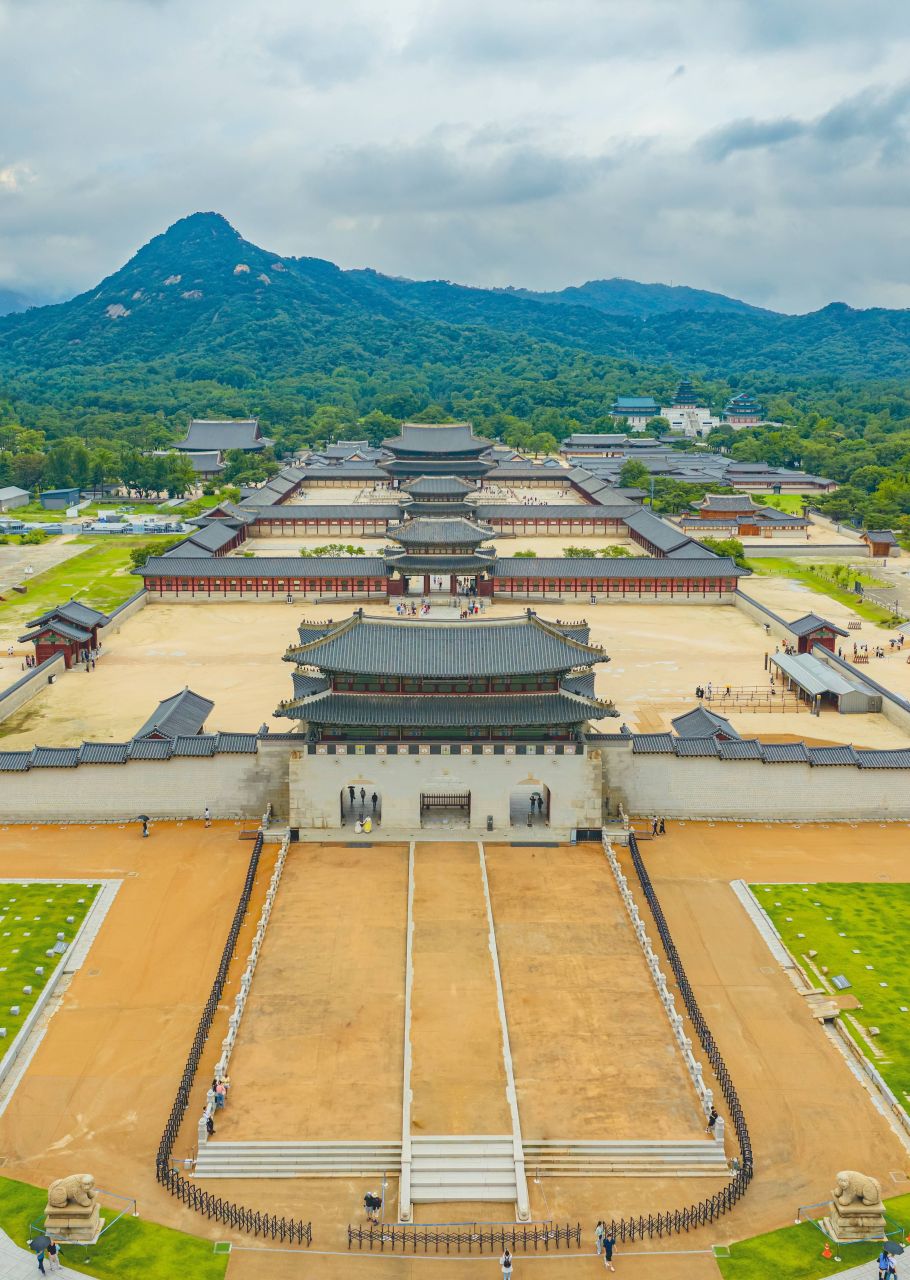
A practical order for a first visit: enter through Gwanghwamun in time for the 10 AM Royal Guard Ceremony, move through Geunjeongjeon and Gyeonghoeru while the courtyards are still relatively empty, then head north toward Hyangwonjeong Pavilion for a quieter stretch before the midday crowds arrive. From there, the National Palace Museum of Korea sits just inside the palace’s western wall and makes a good indoor break, particularly on hot or rainy days. For an unusual vantage point, the fourth floor of the National Museum of Korean Contemporary History, just across from Gwanghwamun, offers a wide aerial view over the entire palace complex — worth the short detour if you want a single photo that captures the whole layout.
Accessibility and Facilities
- The main paths through the central courtyards are wide and mostly flat, but stone thresholds, gravel and steps around the smaller pavilions can be tricky with a wheelchair or stroller.
- Wheelchairs and strollers can be borrowed at the information center near the main entrance, first come, first served.
- Restrooms are spread across the grounds, but there are no proper restaurants inside, so plan to eat in Samcheong-dong or Bukchon before or after your visit.
Nearby Places to Combine With Your Visit
Pairing Gyeongbokgung Palace with one or two nearby sites is the most efficient way to fill out a half-day without excessive backtracking. Bukchon Hanok Village (Naver Map | Google Maps) is about a 10–15 minute walk from the palace’s eastern side and offers narrow hanok-lined lanes for wandering after the wide open palace courtyards — note that the Bukchon-ro 11-gil section is restricted to tourist visits between 10:00 and 17:00 only, so plan that leg of the walk for daytime.
Inside the palace grounds itself, the National Palace Museum of Korea (Naver Map | Google Maps) houses more than 40,000 Joseon-dynasty artifacts and makes for a low-effort add-on since it doesn’t require leaving the palace complex. Just beyond it, the National Folk Museum of Korea (Naver Map | Google Maps) focuses on everyday traditional life and has a dedicated children’s section, making it a good pick for families traveling with kids who might not be as engaged by the palace halls alone.
Frequently Asked Questions
How long should I plan for a Gyeongbokgung Palace visit?
Budget at least 1.5 to 2 hours for a focused walk through the main halls, and closer to 3 to 5 hours if you’re wearing a hanbok, taking photos, or adding the National Palace Museum of Korea or National Folk Museum of Korea to the same trip. Rushing the visit is the most common regret among first-time visitors.
Is Gyeongbokgung Palace worth visiting for first-timers?
Yes — as the largest of Seoul’s five Joseon palaces, it offers the widest range of halls, gardens, and photo spots in a single, easily reached location, making it the natural starting point for anyone new to Korea’s palace culture. Combining it with the Royal Guard Ceremony and a nearby hanbok rental adds context that a simple walk-through wouldn’t give.
How can I get free entry to Gyeongbokgung Palace?
Wearing a complete hanbok gets anyone in for free, regardless of nationality or age, and it’s the option most visitors use. Visitors aged 18 and under (Korean nationals up to age 24), seniors 65 and older, and everyone visiting on the last Wednesday of the month also enter without charge — bring a passport or ID.
Can solo travelers comfortably wear a hanbok and visit alone?
Yes — solo visitors wear hanbok at the palace regularly, and rental shops near the entrance are used to dressing single travelers, often offering simple self-timer or tripod-friendly spots inside the grounds. It’s a common and comfortable choice, not one that stands out.
What are the must-see highlights inside the palace?
Geunjeongjeon (the main throne hall), Gyeonghoeru Pavilion on its reflecting pond, and the quieter Hyangwonjeong Pavilion in the northern gardens are the three most frequently recommended stops. Timing your visit around the 10 AM or 2 PM Royal Guard Ceremony at Gwanghwamun Gate is also considered essential by most repeat visitors.
In Conclusion
Gyeongbokgung Palace rewards a little upfront planning: know that it’s closed on Tuesdays, that a hanbok gets you in free, and that the Royal Guard Ceremony runs twice a day at Gwanghwamun, and the rest of the visit falls into place naturally. Arrive early, give yourself at least two unhurried hours, and push north to Hyangwonjeong Pavilion where the crowds thin out. Pair it with the National Palace Museum of Korea or a short walk into Bukchon Hanok Village, and what could have been a confusing half-day turns into one of the smoothest stops on a Seoul itinerary.
Discover more from Korea Visiting
Subscribe to get the latest posts sent to your email.