A one day in Dongdaemun itinerary works best when you stop treating DDP, Gwangjang Market, and the night shopping malls as three separate outings and instead let them flow into each other across an afternoon and evening. This district near Dongdaemun History & Culture Park Station rewards a late start more than an early one — the food alleys hit their stride at lunch, the futuristic curves of DDP photograph best as the light fades, and the malls don’t really wake up until after dark. I’ve built this route around that natural rhythm: afternoon at DDP, an early dinner crawl through Gwangjang Market, then a few hours of night shopping before the last trains stop running. It’s realistic for one day, not a checklist that leaves you sprinting between subway exits.
Key Takeaways
- Start around 1–2 PM at DDP, eat dinner at Gwangjang Market by 5–6 PM, then shop the malls until 10–11 PM — this order matches when each place is actually at its best.
- Gwangjang Market’s food street stays open into the evening daily, but many fabric and hanbok stalls close on Sundays, though some individual hanbok shops may operate with varied hours, so plan textile browsing for another day of the week.
- The walk between Gwangjang Market and the DDP/mall area takes about 10–14 minutes, or 1–3 minutes by subway (Line 1, one stop) — no need to rush.
- DDP’s “Dream in Light” facade lighting runs roughly 6–10 PM, so time your visit there for early evening if night photos matter to you.
- Night malls keep going long after dinner — Doota until midnight, Migliore later still — but pace yourself — after 9 PM the crowds and the fluorescent lighting get overwhelming fast.
Afternoon — Dongdaemun Design Plaza (DDP)
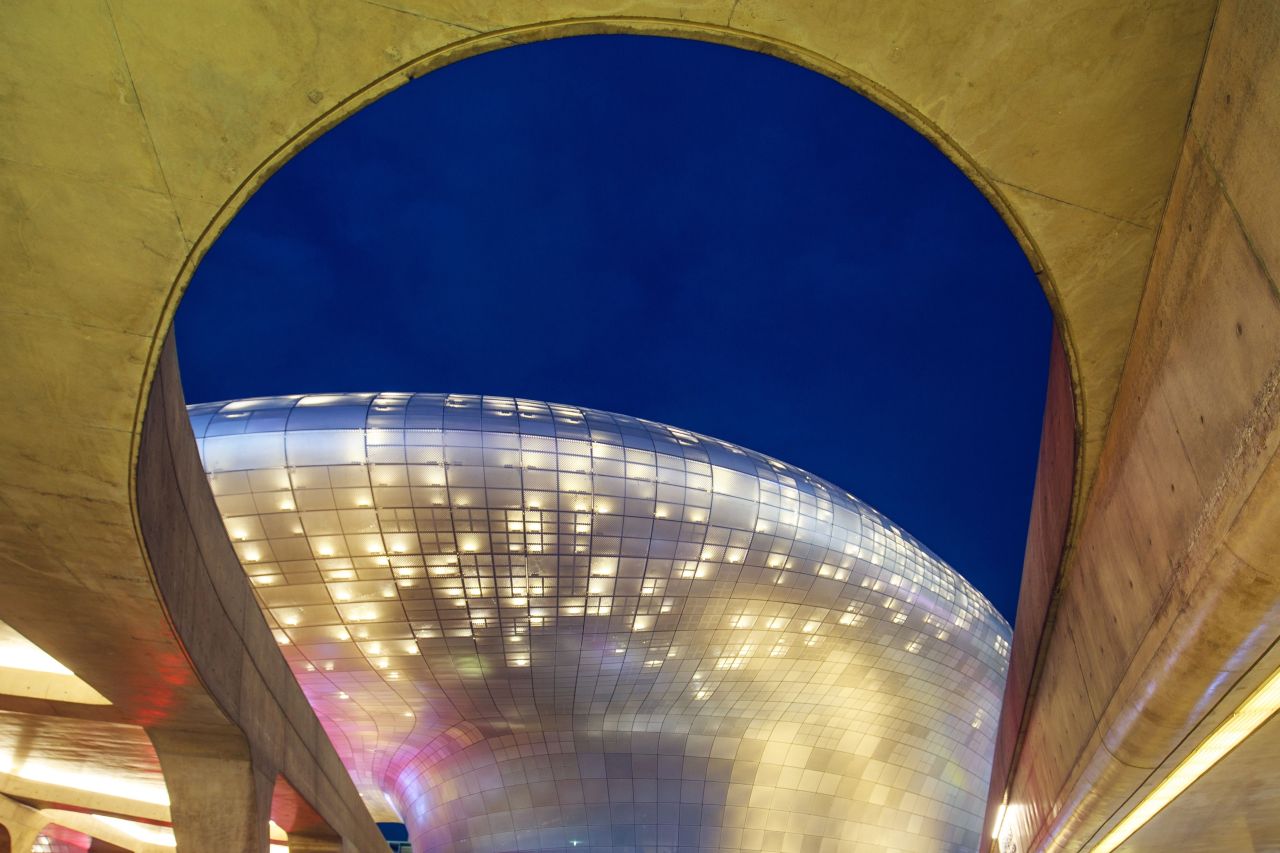
Start your Dongdaemun itinerary at DDP in the early afternoon, when you can explore Zaha Hadid’s curved, futuristic building in daylight before the evening light show takes over. Take the subway to Dongdaemun History & Culture Park Station (Lines 2, 4, 5), Exit 1 — it lets you out almost directly onto the plaza, and you’ll see the building’s silver, spaceship-like shell before you’re even out of the stairwell.
Budget about 1.5 to 2 hours here. The building itself is free to walk through and photograph, and I’d treat the architecture as the main attraction rather than rushing into any single exhibition hall — the exterior curves, the sunken plaza, and the LED rose garden (Design Market & Eoullim Plaza area) are worth more of your time than most first-timers expect. If a specific exhibition interests you, check what’s running that week; some exhibitions charge separate admission on top of the free building access. Between March and November, DDP occasionally runs rooftop tours that require advance booking through the official DDP website — worth checking before your trip if you’re visiting in spring or fall, since walk-up slots aren’t guaranteed.
My honest take: DDP splits opinion. If you love bold architecture, it’s a genuine highlight. If buildings aren’t your thing, an hour is plenty — don’t feel obligated to hunt for every photo spot the internet tells you about. For exact hours, closed days, and the current address, check the Naver Map listing for DDP or the Google Maps entry before you go.
If you have extra time before heading to dinner, the Seoul City Wall trail passes near Dongdaemun Gate (Heunginjimun), just a few minutes’ walk from the station, and Naksan Park’s viewpoint overlooks both DDP and the Seoul skyline — a good option if you’re staying overnight nearby and want sunset views, though it adds a steep uphill walk that will eat into your evening if you’re trying to keep this itinerary to one day.
How do I get from DDP to Gwangjang Market?
From DDP, head to Gwangjang Market by subway or on foot. Walk to Dongdaemun History & Culture Park Station and take Line 2 or Line 4/5 toward Jongno, or simply walk the roughly 10–14 minutes (about 1–1.2 km) west along the main road if the weather’s decent — I’d walk it once the sun starts dropping, since the street itself, lined with fabric wholesalers, is part of the Dongdaemun texture worth seeing. By taxi, the ride is about 5 minutes and roughly ₩5,000–6,000 (close to the base fare) — barely worth it unless you’re loaded down with shopping bags already.

Early Evening — Dinner at Gwangjang Market
Time your Gwangjang Market visit for dinner, arriving by about 5–6 PM when the food alleys are lively but not yet at their most crowded. This is Korea’s first permanent market, and its food street — connected to the East Gate, North Gate 2, and South Gate 1 — is what draws most visitors now, more than the wholesale fabric and hanbok trade that built the place. Take the subway to Jongno 5-ga Station (Line 1), Exit 7, 8, or 9, which puts you right at the market’s edge.
Budget 1 to 1.5 hours for eating and wandering. Start with bindaetteok (mung bean pancake) — it’s the market’s signature dish, and the smell of it frying in big shallow pans is what first hits you as you step into the food alley. From there, mayak gimbap (bite-sized “narcotic” gimbap, named for how addictive it is, not for any actual ingredient) makes a good light second stop, and a bowl of noodles or soup rounds things out. Expect to spend roughly ₩10,000–20,000 per person for a full round of street food — bring cash, since many of the smaller stalls still don’t take cards, and the aisles are tight enough that fumbling with a card reader slows down the whole line behind you.
My honest take on the crowd: according to Korea Tourism Organization crowd data, Gwangjang Market is least crowded on Tuesdays and busiest on Saturdays, so if your schedule allows, avoid weekend dinnertime if you want elbow room at the stalls. If you’re set on the textile and hanbok side of the market rather than just the food, note that most of those vendors close on Sundays — plan a weekday visit if fabric shopping matters to you. Solo diners should know that some Dongdaemun specialties, like dak-hanmari (whole chicken hot pot) served elsewhere in the district, are portioned for two or more and awkward to order alone; Gwangjang’s stall-by-stall street food format is much friendlier if you’re traveling solo, since you can order single portions and eat standing at the counter.
For the current address and any posted details, see the Naver Map listing for Gwangjang Market or the Google Maps listing, and check the official Gwangjang Market site for vendor updates.
What if I want a sit-down dinner instead of street food?
If street food isn’t your style, the district around DDP has a Central Asian food cluster sometimes called Central Asia Street, with Uzbek and other regional restaurants like Star Samarkand (14 Eulji-ro 42-gil) — a good change of pace if you want plov or shashlik instead of Korean market snacks. It sits closer to the DDP side of the neighborhood, so it also works well as a pre-shopping dinner if you skip Gwangjang entirely.
Night — Shopping at Doota, Migliore & the Malls
Head into Dongdaemun’s night shopping malls after dinner, roughly 7–10 PM, when the district earns its reputation as a market that barely sleeps. From Gwangjang Market, backtrack toward Dongdaemun History & Culture Park Station or Dongdaemun Station — most of the major malls cluster around one of these two stops, so you won’t need more than one more short subway hop or a 10–15 minute walk.
Doota Mall is a solid first stop, with retail floors that stay open until midnight, and some select stores may have extended hours. It’s more curated and tourist-friendly than some of its neighbors, with recognizable brands mixed among smaller boutiques — ABC Mart’s GSA branch in Doota’s basement level is a reliable stop if you need shoes. Migliore, just across the street, has a rawer, more maze-like wholesale feel and stays open very late, into the early morning hours on most nights, though I’d treat any posted closing time as approximate and confirm on-site since retail floors and wholesale floors here run on different schedules. APM Place, nearby, keeps an unusual overnight schedule aimed largely at wholesale buyers and is closed Fridays and Saturdays — skip it on a weekend visit.
Budget 1.5 to 3 hours depending on your stamina; the lighting, crowds, and repetitive stalls wear people down faster than the hours suggest. My honest take on Dongdaemun Market for casual tourists: it’s fundamentally a wholesale district, and buying just one or two retail items here doesn’t always justify the trip unless you genuinely enjoy digging through racks — the deals get better the more you buy, which favors resellers over casual shoppers. If you want quality pieces without the wholesale mindset, focus on Doota’s curated floors rather than the deeper wholesale levels of Migliore.
Is Dongdaemun safe at night, especially for solo travelers?
Dongdaemun is generally considered safe at night thanks to heavy CCTV coverage and constant foot traffic around the main mall strip, but some side alleys away from the lit storefronts can feel dark and empty, which unsettles first-time solo visitors more than the actual risk warrants. Sticking to the main road between Doota, Migliore, and the subway exits keeps you in well-lit, populated areas the entire evening.
For current listings, use the Naver Map link for Migliore or its Google Maps entry, and the official Migliore site; for Doota Mall, see its Naver Map listing or Google Maps entry — it sits directly across from Migliore on the same stretch of Jangchungdan-ro.
Getting Around & Practical Tips
Getting around Dongdaemun for a full day is straightforward because nearly everything sits within a 10–15 minute walk or a one-stop subway ride of Dongdaemun History & Culture Park Station or Jongno 5-ga Station. A T-money card (available at any subway station convenience store) covers subway fares of roughly ₩1,550–2,000 per ride and works on buses too, so there’s no need for a special tourist pass for a single-district day.
Wear comfortable, broken-in shoes — you’ll cover more uneven flooring in the malls and market alleys than the total distance suggests, and standing to eat at Gwangjang Market stalls adds up over an hour. Carry cash in small bills for the market food stalls, since not every vendor takes cards, and keep some extra for the malls, where street-level vendors sometimes negotiate better on cash purchases. If you’re visiting DDP between March and November and want a rooftop tour, book it in advance on the official DDP site — same-day availability is unreliable. If fabric, hanbok, or wholesale textile shopping is a priority rather than just the food street, avoid Sundays at Gwangjang Market, since most of those vendors close for the day while the food stalls stay open.
Pace-wise, this itinerary is built for one realistic day — DDP in the afternoon, dinner at Gwangjang, shopping into the night. Trying to add a full second market (like separately touring the wholesale Dongdaemun clothing complexes beyond Doota and Migliore) or a long detour to Naksan Park on the same day tends to turn a comfortable evening into a rushed one; if the wall trail or park view matters to you, consider it as an early-morning add-on before DDP rather than squeezing it in after dark.
Frequently Asked Questions
Is one day enough for DDP, Gwangjang Market, and night shopping in Dongdaemun?
Yes, one day works well if you sequence it by time of day rather than trying to see everything at once — afternoon at DDP, dinner at Gwangjang Market, then night shopping. Packing in additional stops like Naksan Park or a full wholesale clothing tour on top of these three usually makes the day feel rushed rather than relaxed.
Is Dongdaemun Market worth visiting for clothes as a tourist?
It depends on what you’re after — Dongdaemun is primarily a wholesale district, so buying just one or two retail pieces doesn’t always deliver the value that bulk buyers get. If you enjoy digging through racks and don’t mind a rawer, less curated shopping experience than Myeongdong or Hongdae, the deals and variety are genuinely good, especially at Doota’s more retail-friendly floors.
How do I get from Gwangjang Market to the Dongdaemun night shopping area?
The fastest way is one stop on Line 1 from Jongno 5-ga Station to Dongdaemun Station, about 1–3 minutes and roughly ₩1,550–2,000. Walking takes about 10–14 minutes (around 1–1.2 km) and lets you pass the fabric wholesale stretch along the way; a taxi covers the same distance in about 5 minutes for roughly ₩5,000–6,000 (close to the base fare).
Is Gwangjang Market open in the evening, and is it different from during the day?
Yes — the food street operates daily well into the evening, and it’s arguably at its best after 5 PM when the frying pans are going full speed. Note that the fabric, hanbok, and general goods vendors follow separate, shorter daytime hours and mostly close on Sundays, so an evening visit is really a food-street experience.
Is Dongdaemun safe to walk around at night?
Generally yes — the main mall strip along Jangchungdan-ro and Eulji-ro is well-lit, heavily trafficked, and covered by CCTV, and it’s a popular reason locals recommend staying near Dongdaemun given the strong subway connectivity, especially Line 4. Some quieter side alleys can feel isolating late at night, so if that’s a concern, stick to the main lit streets between the malls and subway exits.
In Conclusion
This one day in Dongdaemun itinerary works because it follows the district’s natural rhythm instead of fighting it: DDP’s architecture reads best in afternoon light, Gwangjang Market’s food alleys peak at dinnertime, and the night malls don’t hit their stride until after dark. Anchor your day around Dongdaemun History & Culture Park Station and Jongno 5-ga Station, budget realistic time at each stop rather than rushing, and keep cash on hand for the market stalls. Skip the temptation to cram in a full wholesale clothing tour or a Naksan Park detour on the same day — save those for a return visit if this neighborhood grabs you. Done at this pace, Dongdaemun delivers a genuinely full, unhurried day that ends with the district still buzzing around you as you head home.
Discover more from Korea Visiting
Subscribe to get the latest posts sent to your email.