Riding Seoul buses with a T-money card is straightforward once you understand the color-coding system, the tap-on/tap-off rule, and roughly how much each ride costs. Seoul’s bus network is one of the most extensive and affordable in Asia, but first-time visitors often freeze at the door because buses no longer take cash, drivers pull away quickly, and stop names are announced only in rapid Korean and English. The good news: once you know the five main color categories and have a working transportation card in hand, riding a Seoul bus is no harder than tapping a card twice and watching a screen. This guide breaks down exactly what each bus color means, how much you’ll pay in 2026, which card fits your trip style, and the small habits (tapping off, pressing the bell, watching the stop signs) that separate a smooth ride from a missed stop.
Key Takeaways
- Seoul buses are color-coded by function: Blue and Green (₩1,500) for main and feeder routes, Yellow (₩1,400) for downtown loops, Red (₩3,000) for express routes to the suburbs, and Night “Owl” buses (₩2,500) after midnight.
- Most city buses no longer accept cash — you need a T-money card, Climate Card, or a foreigner card like WOWPASS/Mpass.
- Always tap your card both when boarding and when exiting; skipping the tap-off can cost you the transfer discount or the maximum fare on your next ride.
- Transfers between bus and subway are discounted for up to four transfers (five rides) within about 30–60 minutes on the same card.
- Naver Map and KakaoMap show real-time bus arrival times and are more reliable in Korea than Google Maps.
Understanding Seoul’s Bus Color System
Seoul’s buses are grouped into five color categories, and knowing what each color does is the fastest way to figure out which bus you actually need. Blue buses (jwa-seon, mainline) are the workhorses of the network — long routes connecting major districts across the city, often running along main roads with dedicated bus lanes. Green buses handle shorter, feeder-style routes, linking residential neighborhoods to subway stations or to a Blue bus line; smaller Green buses that circulate within a single neighborhood are called “Maeul” or Village buses, which are charged at their own lower fare, and they’re the ones you’ll see squeezing through narrow alleyways. Yellow buses are circular routes that loop around central Seoul’s core districts, often passing multiple tourist landmarks in one continuous loop, which makes them genuinely useful for sightseeing. Red buses are express/rapid routes that connect Seoul to satellite cities and suburbs — expect fewer stops, higher speed, and highway sections. Finally, Night buses (nicknamed “Owl Buses” or Simya bus) run on a limited set of routes roughly between 11:10 PM and 6:00 AM, filling the gap after the subway closes. The route number itself also hints at the bus’s role: numbers are typically assigned by district and route type, so checking the number against a map app before boarding is worth the extra ten seconds.
T-money Card: What It Is and Why You Need One
T-money is the rechargeable smart card that Seoul’s entire public transport system runs on, and without one — or an equivalent card — boarding most city buses is genuinely difficult. Cash payment has been phased out on the large majority of Seoul city buses since 2021, so a physical tap card isn’t a convenience anymore; it’s close to a requirement. The card itself costs about ₩3,000–₩5,000 (as of 2026) and that purchase price is non-refundable, separate from whatever balance you load onto it. You can buy one at almost any convenience store — GS25, CU, 7-Eleven, or emart24 — as well as at subway station information counters, new automated ticket kiosks found in stations on Lines 1–8, and dedicated T-money vending machines at Incheon Airport. Topping up is simple: hand cash to a convenience store clerk and ask them to charge the card, or use a subway station’s charging machine. These machines primarily accept cash (Korean Won) for T-money top-ups; international credit and debit cards are generally not accepted. The minimum top-up is generally about ₩1,000, and the card can hold up to ₩500,000. Beyond buses and subways, T-money also works on many taxis and at some convenience stores and vending machines, making it useful well beyond transit.
T-money vs Climate Card vs WOWPASS: Which Card Fits Your Trip?
The right transit card depends less on brand loyalty and more on how long you’re staying and how far outside Seoul you plan to travel. Here’s how the main options stack up:
- T-money card — Pay-as-you-go, works everywhere in the country (buses, subways, most taxis), no time limit, refundable balance (minus a small fee) when you leave. Best for: almost every traveler, especially those doing day trips outside Seoul, since it works on Red express buses and regional transport that other passes don’t cover.
- Climate Card (Ttamungnyeo Card / Climate Card) — Unlimited rides on Seoul’s subway and city buses for a fixed period; short-term tourist passes are available, for example about ₩5,000 for one day or about ₩20,000 for seven days (as of 2026), on top of a ₩3,000 physical card fee. Best for: travelers staying mainly inside Seoul who plan to ride the subway or bus multiple times a day, since heavy daily use can make the flat rate cheaper than pay-per-ride. Note: it does not cover Red express buses or the airport train (AREX), so it won’t help on suburban day trips.
- WOWPASS / Mpass — Prepaid cards designed specifically for foreign visitors, combining a transit card with currency exchange and payment functions; Mpass, for instance, allows up to 20 rides per day on Seoul’s subway, buses, and AREX (excluding express trains). Best for: short-stay tourists who want one card that also handles currency exchange and retail payments, without needing to visit a bank.
For most first-time visitors splitting time between central Seoul and at least one day trip (Suwon, Incheon, the DMZ, etc.), a standard T-money card is the simplest, most flexible choice. If your itinerary is Seoul-only and transit-heavy, compare the Climate Card’s flat rate against your expected number of rides before deciding.
How to Ride a Seoul Bus, Step by Step
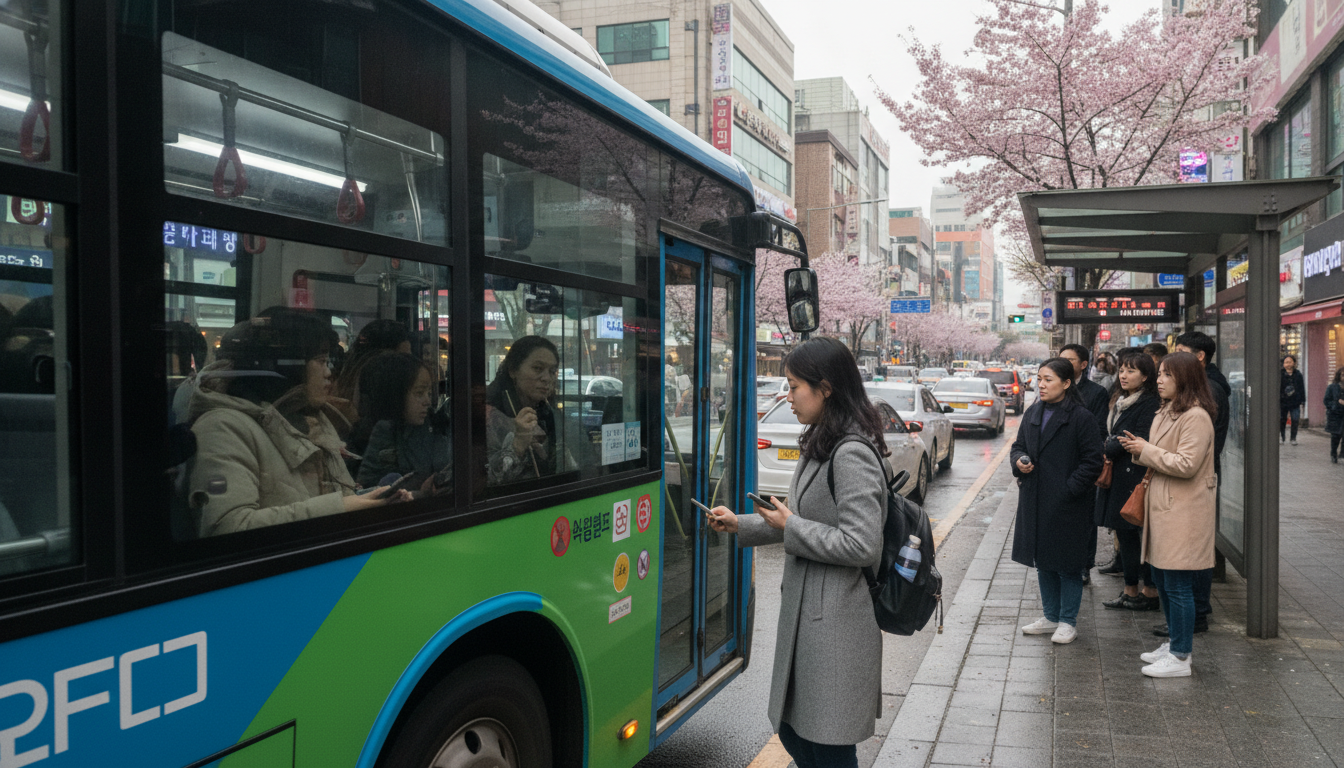
Riding a Seoul bus comes down to four repeatable steps: find the right stop, board through the correct door, tap your card twice, and get off at the right time. Have your card out and ready before the bus arrives — Seoul buses stop briefly and pull away fast, so fumbling for a card in a bag can mean a missed ride. Board through the front door for almost all bus types (Red express buses, in particular, use the front door for both boarding and exiting), tap your card on the reader near the driver, and wait for the confirmation beep and fare display. If you’re traveling with others, tell the driver the number of passengers before tapping, since a single tap by default charges for one rider only — you may need to tap once per person or tell the driver to charge multiple fares. Once seated, watch the digital display or listen for the stop announcement (usually given in Korean, then English), and press the red or yellow stop bell mounted near the seats or on poles well before your stop — pressing it too late means the driver may not have time to pull over safely. Exit through the rear (middle) doors for most bus types, and always tap your card on the reader by the exit door before stepping off. This tap-off step is not optional: it registers your total distance for correct fare calculation and is required to keep any transfer discount active.
Bus Fares in Seoul: How Much Will You Pay?
Bus fares in Seoul depend on the color of the bus, and paying with a T-money-type card is both cheaper and, on most routes, the only accepted payment method. As of 2026, adult fares using a transportation card are approximately: Blue and Green buses ₩1,500, Yellow circular buses ₩1,400, Red express buses ₩3,000, Local (Maeul/Village) buses ₩1,200, and Late-Night Owl buses ₩2,500. Youth and child fares are discounted below the adult rate, though the exact discount requires registering age on the card, which is mainly relevant for long-term residents rather than short-term tourists. Paying cash, where still accepted, typically costs about ₩100–200 more per ride than the card fare and is increasingly rare — most drivers will simply point you toward a convenience store if you try to pay in cash without a card. One of the best financial perks of the system is the transfer discount: transferring between bus and subway (in any combination) up to four transfers (five rides) within about 30 minutes — extended to about 60 minutes between 9 PM and 7 AM — using the same card results in reduced or free fares on the connecting legs. This makes multi-leg trips across the city dramatically cheaper than paying separately for each ride, but only if you tap off correctly every single time.

Decoding Physical Bus Stop Signs
Seoul’s physical bus stop signs carry more useful information than most first-timers realize, and reading them correctly can save you from boarding the wrong bus entirely. Each sign lists the stop’s name (in Korean and English) along with a stop ID number, which you can enter into Naver Map or KakaoMap to pull up real-time arrival predictions even without recognizing a single Korean character. Below the stop name, route numbers are displayed in colored boxes matching the bus’s color category — a blue box means a Blue mainline bus stops there, a red box a Red express bus, and so on — so you can pre-confirm you’re standing at the right curb before a bus even arrives. Pay attention to whether you’re at a median (center-of-road) stop or a roadside stop: median stops, common along major avenues, serve buses traveling in both directions from the same platform, while roadside stops only serve one direction, so standing at the wrong side of a road can mean waiting for a bus going the opposite way. Digital displays at busier stops show live countdown timers and the next few arriving buses by number, which is the single most reliable real-time check if you’re unsure whether you’re in the right spot.
Common Mistakes and Insider Tips for First-Time Riders
The most common first-timer mistake on Seoul buses is forgetting to tap off, which either voids a transfer discount or results in being charged the maximum possible fare on the next tap-on — an easy and entirely avoidable loss. A close second is assuming cash works everywhere; since most city buses phased out cash payment around 2021, arriving at the door without a loaded card can mean an awkward standoff with the driver, so always load extra balance before you need it, not when you’re already boarding. Another frequent issue is misjudging boarding speed — Seoul bus drivers keep tight schedules and don’t wait long at each stop, so having your card out, knowing your stop name in advance, and standing near the door as your stop approaches will prevent a rushed, stressful exit. For navigation, download Naver Map or KakaoMap before your trip rather than relying on Google Maps, which is notably less accurate for Korean bus routes and real-time arrivals. If you want an easy, low-stress way to see the city by bus, the hop-on-hop-off Seoul City Tour Bus — including its Downtown Palace & Namsan Route and Night View Route — removes the guesswork of stops and transfers entirely. Finally, remember basic etiquette: seats near the doors are reserved for elderly, pregnant, and disabled passengers, and standing passengers should hold the overhead straps, since Seoul bus drivers brake and accelerate briskly.
Frequently Asked Questions
Do I need to tap my card when getting off the bus?
Yes. Tapping off (exit tap) is required on nearly all Seoul city buses to calculate your correct fare based on distance traveled and to preserve any active transfer discount. Skipping it can cause you to lose the transfer benefit or be charged the maximum fare the next time you tap on with the same card.
How do I pay for multiple people with one T-money card?
Tell the driver how many passengers are boarding before you tap, since a single tap by default registers only one fare. In practice, it’s simplest for each traveler to carry their own card and tap individually as they board.
Which navigation app is best for finding Seoul bus routes?
Naver Map and KakaoMap are the most accurate apps for real-time Seoul bus arrivals, route planning, and stop locations, and both are widely recommended over Google Maps, which has limited transit data in Korea. Search by stop ID number if you’re unsure of a stop’s Korean name.
Can I still pay with cash on Seoul buses?
Cash payment has been phased out on most Seoul city buses since around 2021, and many drivers can no longer accept it at all. It’s strongly recommended to carry a T-money card, Climate Card, or a foreigner-focused card like WOWPASS before boarding.
What happens if I don’t have a T-money card yet when I need to board?
Without a working transit card, boarding most Seoul buses isn’t realistic, so it’s best to buy one in advance at a convenience store, subway station, or airport kiosk. If you’re caught without one, the nearest convenience store (GS25, CU, 7-Eleven, or emart24) can usually sell and charge a card within a minute or two.
In Conclusion
Riding Seoul buses is far less intimidating once the color system clicks: Blue and Green for everyday city travel, Yellow for downtown loops, Red for suburban express trips, and Night Owl buses for the after-midnight gap. Get a T-money card (or Climate Card/WOWPASS depending on your itinerary) loaded before you need it, tap on and off every single time, and lean on Naver Map or KakaoMap for real-time stop and route info. Watch the colored route boxes on physical stop signs, have your card ready before the bus arrives, and press the stop bell early — these small habits are what separate a confident rider from a stressed one. With these basics down, Seoul’s bus network becomes one of the cheapest and most efficient ways to explore the city, from quick neighborhood hops to full-day sightseeing loops.
Discover more from Korea Visiting
Subscribe to get the latest posts sent to your email.