If you’re piecing together a Deoksugung Palace guide before your first trip to Seoul, you’ve probably already hit the same wall every newcomer does: which gate to use, when the guards actually show up, and whether the ticket line is worth the wait. Wedged between the glass towers of City Hall and the quiet stone-walled lane of Jeongdong-gil, Deoksugung can feel like an afterthought next to Gyeongbokgung — until you realize it’s often the calmer, more atmospheric option, especially after dark. This guide covers exactly what a first-time visitor needs to know: the admission cost, the fastest subway route, when the Royal Guard Changing Ceremony actually happens, and which corners of the grounds — like Seokjojeon Hall’s Western-style columns — deserve a slower walk-through.
Key Takeaways:
- Admission is inexpensive (about 1,000 KRW for adults), and free for seniors, young children, Hanbok wearers, and on the last Wednesday of every month.
- The Royal Guard Changing Ceremony happens three times daily in front of Daehanmun Gate.
- Deoksugung is closed every Monday, so build that into your schedule.
- City Hall Station puts you at the palace entrance in under five minutes on foot.
- Jeongdong Observatory, just up the road, offers a free bird’s-eye view of the palace grounds.
📍 Deoksugung Palace — Essential Information
| Address | 99 Sejong-daero, Jung-gu, Seoul |
| Opening hours | [General admission] 09:00-21:00 (Last admission 20:00) [Exhibition] Seokjojeon Hall 09:30-17:30 (Last docent 16:30) Dondeokjeon Hall 09:00-17:30 (Last admission 17:00) Jungmyeongjeon Hall 09:30-17:30 (Last admission 17:00) |
| Closed | Mondays (Closed the following business day in the case of Monday being a national holiday) |
| Parking | Not available |
| Website | royal.khs.go.kr |
| Best time to visit | Least crowded on Sundays; busiest on Fridays (Korea Tourism Organization crowd forecast) |
| Map | Google Maps · Naver Map |
Deoksugung Palace Guide at a Glance
- Why visit: Deoksugung mixes traditional Joseon-era halls with a genuine Western-style stone building, so it feels different from every other palace in Seoul in a single walk.
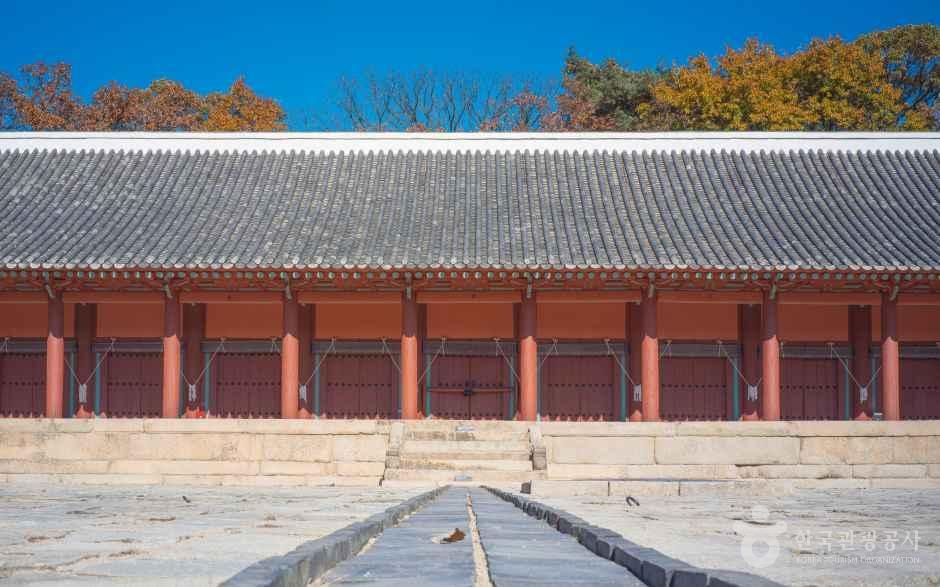
- What you will see: wooden throne halls, the neoclassical Seokjojeon Hall, the octagonal Jeonggwanheon pavilion, a small pond, and stone-wall lanes that spill out into the surrounding Jeongdong neighborhood.
- Getting there: City Hall Station (Line 1 or 2) puts you right outside Daehanmun Gate — most visitors are inside within two to five minutes of walking.
- Tickets and admission: general entry is roughly 1,000 KRW for adults and 500 KRW for children, with free entry for seniors, young children, Hanbok wearers, and on Culture Day.
- Tips from past visitors: arrive before 11 a.m. on a weekday to beat the crowds, and don’t skip an evening visit — the illuminated stonework has a different mood entirely.
- Nearby spots worth combining: Daehanmun Gate for the guard ceremony, Jeongdong Observatory for a rooftop view of the whole complex, and City Hall Station area for a quick transit connection onward.

The Royal Guard Changing Ceremony at Daehanmun Gate
The Royal Guard Changing Ceremony takes place directly in front of Daehanmun Gate three times a day — at 11:00, 14:00, and 15:30 — and runs for about 20 to 30 minutes. It’s cancelled on Mondays along with the rest of the palace, and it’s also called off on days with heavy rain or extreme weather, so it’s worth having a backup plan if the sky looks unstable.
The ceremony itself reenacts the historical changing of the palace guard, with performers in reproduction Joseon-era uniforms marching in formation, exchanging ceremonial tokens, and performing a short procession along the gate’s approach. Because it happens right at street level in front of the gate, there’s no ticket needed to watch — you can simply stand along the barricades that staff set up shortly beforehand. Arriving 10–15 minutes early gets you a spot in the front row without needing to jostle for position once the crowd builds. After the formal sequence wraps up, guards typically remain nearby for a few minutes, and this is the window when photos with them are usually possible — a detail a lot of visitors miss because they walk off right as the drums stop. If you only have time for one ceremony, the 11:00 slot tends to draw a lighter crowd than the afternoon sessions.
East Meets West: Seokjojeon Hall and Jeonggwanheon Pavilion
Deoksugung’s most distinctive feature isn’t a wooden hall — it’s the fact that a full neoclassical Western building sits inside a Joseon palace at all. Seokjojeon Hall, with its columned facade and symmetrical stone construction, was built during Korea’s push toward modernization in the early 20th century, and it now functions as an exhibition space tied to that period of change. Its wide front steps and formal garden make it one of the most photographed corners of the palace, and the contrast shows up especially well in early morning or late afternoon light, when shadows fall cleanly across the columns.
A short walk away, Jeonggwanheon pavilion takes the East-meets-West idea in a different direction: a Korean royal pavilion built with Western architectural touches like cast-iron columns and a covered veranda, originally used by the royal family for receiving guests and drinking coffee — one of the earliest documented spots in Korea associated with that habit. It’s smaller and easy to walk past if you’re not looking for it, tucked slightly behind the main hall cluster, but it rewards a slower pace far more than a quick photo stop. Together, Seokjojeon and Jeonggwanheon are the clearest physical evidence of how Deoksugung functioned as a residence during a period when Korea was actively absorbing Western influence while trying to hold onto its own identity — a tension you can feel just by standing between the two buildings.
Getting to Deoksugung Palace from City Hall and Seoul Station
The most direct route to Deoksugung Palace is City Hall Station on Seoul Subway Line 1 or Line 2 — take Exit 1, 2, or 12, and you’ll reach Daehanmun Gate in about two to five minutes of walking, no transfers or confusing intersections involved. If you’re staying near Seoul Station, hop on Line 1 for a short two-to-five-minute ride to City Hall Station, making it one of the easiest palace connections from that side of the city.
Because the walk from the subway exit is so short and mostly flat, this is a genuinely low-effort stop to slot into a longer day covering City Hall, Jeongdong-gil, or Cheonggyecheon stream — all of which sit within easy walking distance of each other. There’s no dedicated parking at the palace, so public transit or a taxi drop-off near the gate is the practical choice if you’re not arriving on foot from a nearby hotel.
Admission Fees, Free Entry Days, and the Combination Ticket
Deoksugung Palace charges a modest entrance fee of about 1,000 KRW for adults (ages 19–64) and 500 KRW for children (ages 7–18), which makes it one of the more affordable palace visits in Seoul. Entry is free for children under 7, seniors aged 65 and over, anyone wearing a Hanbok, and for everyone on the last Wednesday of each month, which is designated Culture Day.
If you’re planning to see more than one palace during your trip, the combination ticket covering four palaces plus Jongmyo Shrine costs 10,000 KRW and stays valid for three months — a worthwhile option if Gyeongbokgung, Changdeokgung, or Jongmyo Shrine are also on your itinerary. Tickets are sold at the entrance near Daehanmun Gate, and lines are generally short compared to the busier palaces, so arriving without a pre-booked slot isn’t usually a problem.
Best Time to Visit: Crowds, Mornings, and Night Views
The lightest crowds at Deoksugung Palace tend to fall on Sundays, while Fridays run the busiest, based on relative visitor concentration tracked over recent weeks — useful to know if you’re trying to time a quieter walk-through. Weekday mornings before 11 a.m. carry the same advantage, letting you wander the grounds and photograph Seokjojeon Hall without dodging tour groups.
Evening visits deserve more attention than they usually get. With the palace open until 21:00 (last admission 20:00), a visit after sunset transforms the atmosphere entirely — the stone facades take on a warmer glow under lighting, the crowds thin out noticeably, and the contrast between the traditional wooden halls and the illuminated Western-style buildings becomes much more striking than it is in daylight. If romance or photography is the priority, a night visit is arguably the better version of this palace. Just remember it’s closed entirely on Mondays, so a Sunday evening or a Tuesday-through-Friday night visit are the realistic windows.
Jeongdong Observatory: A Free Panoramic View of the Palace
Most first-time visitors never learn about Jeongdong Observatory, which sits on the 13th floor of the Seoul City Hall Seosomun building and offers a free, wide-angle view straight down onto Deoksugung’s rooftops and courtyards. It’s an easy add-on if you’re already near the palace, since it’s just a short walk along Deoksugung-gil, and there’s a small cafe inside where you can sit with a drink while looking out over the grounds — the walls are lined with old photographs of the surrounding Jeongdong neighborhood, which adds some context to what you’re seeing below.
Because it’s not widely advertised, the observatory rarely feels crowded, making it one of the better spots to get an orientation shot of the entire palace layout before or after walking through it at ground level. It works especially well earlier in the day, when the light angle helps separate the traditional roof tiles from the neoclassical stonework of Seokjojeon Hall below.
Things to Do Around Deoksugung Palace
Once you’re through the gates, the surrounding Jeongdong neighborhood rewards a bit of extra wandering. The stone wall lining Deoksugung’s perimeter is one of Seoul’s more atmospheric walking paths, especially in the stretch known locally as Gojong’s Trail, where the emperor is said to have walked between the palace and nearby diplomatic buildings during a pivotal period of Korean history — a detail that adds weight to what would otherwise be just a pleasant tree-lined sidewalk.
If you’re basing yourself near Seoul Station rather than downtown, Soda Stay Seoul Station is a practical option that keeps you one Line 1 ride away from City Hall Station and the palace entrance, useful if you’re planning an early-morning visit before the crowds pick up. Combine the palace with a walk to City Hall itself or a stroll toward Cheonggyecheon stream, and you’ve got a half-day loop that covers history, architecture, and a bit of downtown Seoul without much backtracking.
Frequently Asked Questions
What are the admission fees for Deoksugung Palace?
Adults (ages 19–64) pay about 1,000 KRW, and children (ages 7–18) pay about 500 KRW. Entry is free for children under 7, seniors 65 and older, visitors wearing Hanbok, and everyone on the last Wednesday of the month (Culture Day). A combination ticket covering four palaces and Jongmyo Shrine costs 10,000 KRW and is valid for three months.
When is the Royal Guard Changing Ceremony held at Deoksugung Palace?
It takes place in front of Daehanmun Gate three times a day, at 11:00, 14:00, and 15:30, and lasts about 20 to 30 minutes. It doesn’t run on Mondays or in heavy rain, so check the weather before planning around a specific slot.
Is it worth visiting Deoksugung Palace at night?
Yes — many visitors consider the evening the best time to see it, since the palace stays open until 21:00 and the illuminated stonework of Seokjojeon Hall creates a noticeably different, more romantic atmosphere than a daytime visit. Crowds also tend to thin out after early evening.
Can I jog or exercise inside Deoksugung Palace?
No, jogging and running are not permitted within the palace grounds, since it’s treated as a protected historic site rather than a public park. If you’re looking for a place to run nearby, the Cheonggyecheon stream within walking distance is a commonly recommended alternative.
Are guided tours of Seokjojeon Hall available in English?
An in-depth docent tour of Seokjojeon Hall is available in English at specific times, and booking is required. Individual entry without a guide is not permitted for the interior of Seokjojeon Hall, though English translations for exhibits are generally limited.
In Conclusion
Deoksugung Palace rewards visitors who show up with a plan rather than wandering in blind: know that City Hall Station drops you at the gate in minutes, that admission is only about 1,000 KRW, and that the Royal Guard Changing Ceremony runs at 11:00, 14:00, and 15:30 in front of Daehanmun Gate. Beyond the ceremony, the real payoff is slowing down at Seokjojeon Hall and Jeonggwanheon pavilion, where Korea’s traditional and modernizing identities sit side by side, and swinging by Jeongdong Observatory for a free rooftop view before or after your walk. Whether you visit on a quiet Sunday morning or come back for the illuminated evening atmosphere, Deoksugung is one of the easiest, least stressful palace visits in central Seoul.
Discover more from Korea Visiting
Subscribe to get the latest posts sent to your email.