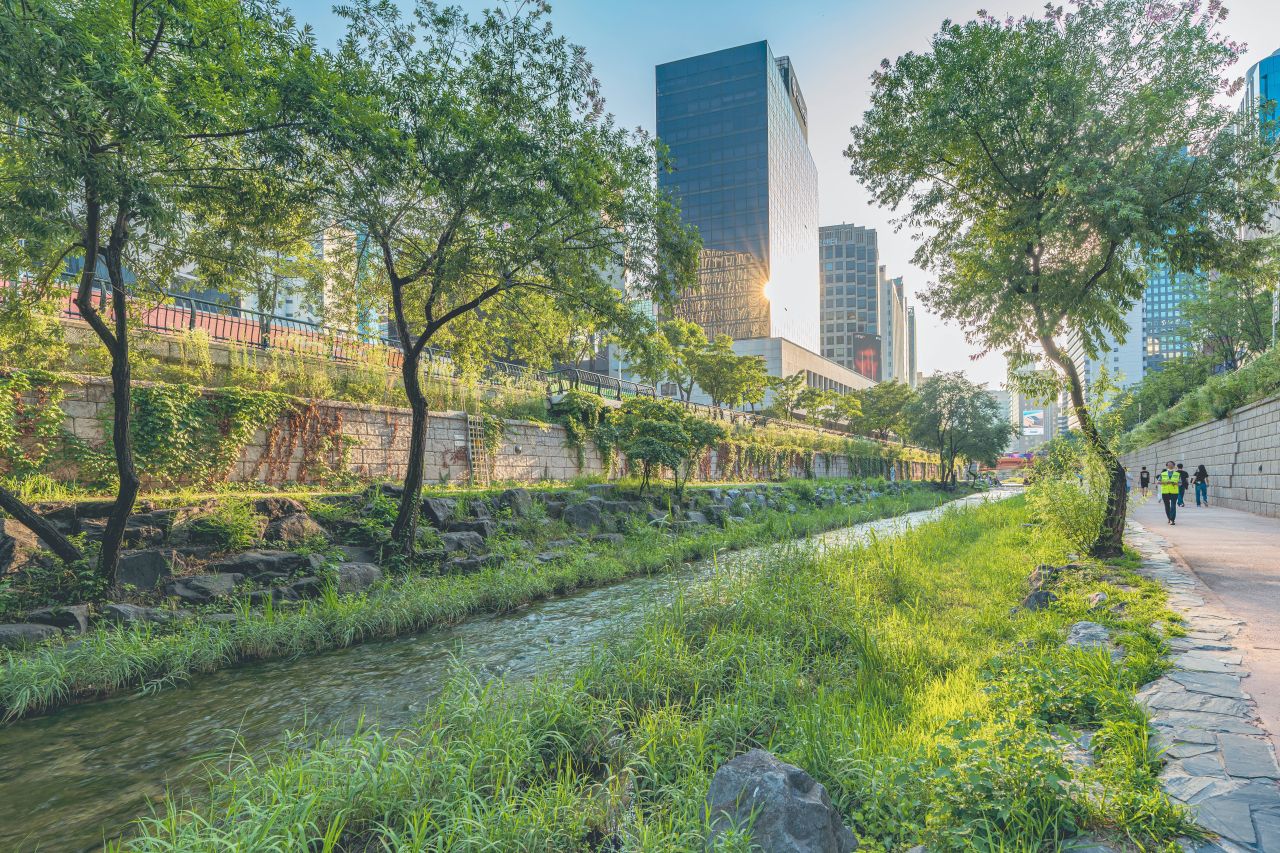
If you’re piecing together a Cheonggyecheon Stream night walk guide because you can’t tell which entrance to use, when the lights actually turn on, or whether the whole 11-kilometer stream is even walkable in one evening, you’re asking the right questions before you go, not after you’re already lost in an underpass. Most first-timers arrive at Gwanghwamun Station expecting a park and instead find a set of stairs leading down into a sunken channel between office towers — a layout that surprises people every time. The stream splits neatly into a western plaza section packed with photo spots, a quieter central stretch lined with old bridges, and an eastern run toward Dongdaemun where the crowds thin out fast. Knowing which section fits your time, your pace, and whether you’re chasing daylight sculptures or evening reflections changes the whole visit.
Key Takeaways
- Cheonggyecheon Stream is free to enter, stretches about 10.9–11 km with roughly 8.4 km of open walking path, and never closes.
- Gwanghwamun Station (Line 5, Exit 5) puts you at Cheonggye Plaza, the busiest and most photogenic starting point, in under 3 minutes.
- Illuminations switch on around 18:00–19:00; the 20–40 minutes after sunset (“blue hour”) give the sharpest night photos.
- Walking the full length takes 2–4 hours at a relaxed pace — most visitors only need 45–90 minutes for the highlight stretch.
- The Seoul Lantern Festival (roughly December–January) turns the plaza-to-Gwanggyo section into the single best reason to visit after dark.
📍 Cheonggyecheon Stream — Essential Information
| Address | Changsin-dong, Jongno-gu, Seoul |
| Closed | N/A (Open all year round) |
| Website | www.sisul.or.kr |
| Map | Google Maps · Naver Map |
Cheonggyecheon Stream at a Glance
- Why visit: It’s the rare Seoul attraction that costs nothing, never closes, and drops the noise of the city by several decibels within one flight of stairs — a genuine escape hatch in the middle of downtown traffic.
- What you’ll see and experience: Fountains and a small waterfall at the western plaza, stepping stones and koi drifting under stone bridges, a mosaic mural of King Jeongjo’s royal procession, and — after dark — projected light and media art rippling across the water.
- Getting there: Gwanghwamun Station (Line 5, Exit 5) is the fastest approach, about a 2–3 minute walk to the plaza; City Hall Station (Lines 1 & 2, Exit 4) and Jonggak Station (Line 1, Exit 5) both work if you’re coming from elsewhere downtown.
- Tickets and admission: Free, with no gate or ticket booth anywhere along the course.
- Tips from past visitors: Go right at sunset for the best light and cooler air, and duck under a stone bridge on hot days — the shaded pockets there run noticeably cooler than the open path.
- Nearby spots worth combining: Gwanghwamun Square, Gyeongbokgung Palace, Myeongdong, and Dongdaemun Market all sit within easy walking or one-stop-subway distance of different points along the stream.

Why Cheonggyecheon Feels Different From Any Other Seoul Attraction
Cheonggyecheon isn’t a park you enter from street level — it’s a corridor you descend into, and that drop is what makes the experience work. The stream sits several meters below the surrounding roads, on the exact footprint of an elevated highway that was demolished and replaced with open water and walking paths in the early 2000s. What looks today like a simple urban stream is really one of Seoul’s most visible pieces of urban planning: a six-lane overpass turned into a place where office workers eat lunch on stone benches and tourists photograph koi fish. I find that most first-timers don’t grasp the scale of that transformation until they’re standing at the bottom looking up at the traffic still moving on the streets above — the contrast between the din up there and the relative quiet down here is the actual “wow” moment, more than any single landmark along the route.
Is Cheonggyecheon Stream worth visiting if I only have a short layover in Seoul?
Yes, if you limit yourself to the plaza-to-Gwanggyo Bridge stretch, which packs in the highest concentration of sculptures, water features, and — after dark — light art within a 20–30 minute walk. Trying to cover the full 8.4 km open section on a tight schedule usually means rushing past the parts that actually made the restoration famous.
How to Get to Cheonggyecheon Stream
Getting to Cheonggyecheon comes down to picking the entry point that matches which section you actually want to see, since the stream runs through several subway lines rather than sitting next to one station. For the western start at Cheonggye Plaza, Gwanghwamun Station (Line 5, Exit 5) is the shortest walk at 2–3 minutes, and City Hall Station (Line 1 & 2, Exit 4) or Jonggak Station (Line 1, Exit 5) work almost as well if you’re already nearby. For the central section — where the stone bridges and the rooftop views around Sewoon Bridge sit — use Euljiro 1(il)-ga Station (Line 2, Exit 2 or 3) or Euljiro 3-ga (Lines 2 & 3). If you’re heading straight for the eastern end near Dongdaemun, Dongdaemun History & Culture Park Station (Lines 2, 4 & 5) drops you closest. One mistake I see constantly: visitors get off at a random station assuming any exit near “Cheonggyecheon” on a map app leads to the same experience, then walk 15–20 minutes in the wrong direction because the western plaza and the eastern Dongdaemun stretch look and feel like entirely different attractions.
Best Walking Route: From Cheonggye Plaza to Gwanggyo Bridge and Beyond
The single best short walk starts at Cheonggye Plaza and ends at Gwanggyo Bridge, covering the fountains, the Spring sculpture, and the media art wall in roughly 20–30 minutes one-way. If you have more time, extend to Supyogyo Bridge and the surrounding bridges for the historical mosaics and a quieter, more local stretch where the crowds noticeably drop off. For a half-day version, continue east toward Euljiro and on to Dongdaemun History & Culture Park Station — this full run takes 2–4 hours at a relaxed pace and trades photo density for genuine quiet, since foot traffic thins out fast past the first kilometer.
What’s the best section for visitors with elderly family members or a stroller?
Stick to the plaza-to-Gwanggyo stretch. The paths there are flattest, best-lit, and shortest between subway exits, so you’re never more than a few minutes from an exit stair if someone needs to stop early — the sections further east have fewer access points and longer gaps between them.
Can you run along Cheonggyecheon?
Yes, and many locals do, but the western section near Cheonggye Plaza gets crowded with sightseers by mid-morning, which makes it frustrating for anyone trying to keep a pace. Runners consistently do better heading east past Euljiro toward Dongdaemun, or going early morning before the tour groups arrive.
Cheonggyecheon Stream Night Walk Guide: Best Spots for Lights and Reflections
The Cheonggyecheon Stream night walk is built around timing more than location — illuminations typically switch on around 18:00–19:00, but the real payoff comes 20 to 40 minutes after sunset, the “blue hour” window when the sky still holds some color and the water reflects both the sky and the surrounding buildings. Start at the waterfall in Cheonggye Plaza, where the falling water catches the plaza lighting and gives you a clean foreground shot before the crowds peak. From there, walk east to the media art installation under Gwanggyo Bridge, where projected patterns move across the underside of the bridge and reflect off the stream — this is the one spot along the entire course where the “media art on water” effect people describe online actually happens, and it’s easy to miss if you’re walking on the upper street level instead of down on the stream path itself. Descending fully into the channel is the trick most people skip: the noise of traffic disappears almost completely once you’re below street level, and the combination of quiet, water sound, and light reflections is what separates the night walk from a daytime stroll through the same stretch.
What time should I go for the best Cheonggyecheon night view?
Arrive right around sunset and stay through the blue hour — going straight after dark misses the transition light that makes reflections pop, and going too late means the plaza crowd has already thinned the atmosphere along with the light quality.
Seoul Lantern Festival and Seasonal Events Along the Stream
The Seoul Lantern Festival is the single biggest reason to time a Cheonggyecheon visit around late December into January, when the stream between the plaza and Gwanggyo Bridge fills with illuminated lantern sculptures lit from 18:00 to 22:00 — recent editions have run roughly December 12 to January 18. Outside of winter, the Lotus Lantern Festival brings a different, more traditional lantern display in May, and the Seoul Christmas Festival adds seasonal lighting and events through December. If your trip doesn’t line up with any of these, don’t worry — the stream’s own permanent lighting and water features still deliver a solid night walk on any evening of the year; the festivals just multiply the density of lanterns and foot traffic for a few weeks at a time.
Things to Do Along Cheonggyecheon Beyond Walking
Walking is the main activity, but the stream rewards slowing down at a handful of specific points rather than just passing through. The Spring sculpture at the plaza entrance is the most-photographed single object on the entire course, and it’s worth circling rather than snapping one shot and moving on — the colors shift depending on the angle of the light. Further along, stepping stones let you cross the water at several points, and kids in particular gravitate toward these; watching koi and other fish drift near the banks is a low-key but genuinely calming stop, especially in the quieter central stretch. The mosaic mural depicting King Jeongjo’s royal procession is easy to walk past without noticing, since it sits along a retaining wall rather than at eye level — it rewards visitors who are actually looking for it rather than passively strolling. For a change of pace, the rooftop-style views near Sewoon Bridge give you an elevated look back down at the stream that most walkers never bother to climb up for.
Cooling Off in Summer: Heat, Bridges, and Mosquitoes
Cheonggyecheon in July and August is a genuinely different experience than in spring or fall, and it’s worth going in with realistic expectations rather than assuming the water automatically cools things down. The underpasses beneath busy roads can turn into what feels like heat chambers, trapping humidity with little airflow — if you’re walking a long stretch in summer, plan to move through these sections quickly rather than lingering. The shaded pockets directly under stone bridges are the actual relief valves: temperatures there drop noticeably and a breeze often channels along the water, which is why you’ll see people clustered under bridges on hot afternoons rather than spread evenly along the path. Some visitors do dip their feet in the shallow water to cool off, and it’s common enough that no one will look twice. The trade-off for summer’s cooler evening walks is mosquitoes, which become a real nuisance after dusk near the water — repellent is worth carrying if you’re planning a longer night walk, especially from late spring through autumn. For overall comfort, late September through October is widely considered the best stretch of the year to walk Cheonggyecheon, since the heat and bugs have faded but the evenings are still mild enough for a long walk.
Finding a Quiet Cafe or Rest Stop Near the Stream
A recurring frustration for visitors is wanting a coffee break with a stream view that isn’t packed with tour groups, and the honest answer is that the busiest window-seat cafes cluster tightly around the plaza and the first few hundred meters east of it — arriving outside peak afternoon hours (late morning or after the dinner rush) is the most reliable way to actually get a seat overlooking the water. Moving further along toward Euljiro or the Supyogyo area spreads out the crowd considerably, and you’ll find quieter, less tourist-facing spots to sit with an iced coffee and people-watch rather than fight for a table. If you want a free indoor break rather than a paid cafe seat, HiKR Ground, a Korea Tourism Organization cultural space near the stream, is worth knowing about as an air-conditioned stop that doubles as a rest point on a hot day.
Combining Cheonggyecheon With Gwanghwamun, Gyeongbokgung, and Dongdaemun
Cheonggyecheon works best as a connector between other downtown stops rather than a stand-alone half-day trip, since its western end sits a short walk from Gwanghwamun Square and Gyeongbokgung Palace, and its eastern end runs almost directly into Dongdaemun Market. A practical sequence is to see Gyeongbokgung Palace and Gwanghwamun Square in the morning, then drop down into Cheonggye Plaza for lunch and a short walk once the midday heat or crowds build up at the palace. From there, following the stream east lines up naturally with an evening at Dongdaemun Market, letting the night walk double as your route between two very different Seoul experiences rather than a separate outing. Myeongdong also sits close enough to the central stream section to fold into the same afternoon if shopping is on your list.
Common Mistakes First-Time Visitors Make at Cheonggyecheon
The most frequent mistake is treating Cheonggyecheon like a single short attraction and only budgeting 10–15 minutes for it, then being surprised that the plaza alone takes longer than that to see properly — the stream is a corridor, not a single viewpoint, and rushing it means missing the sections that make the restoration story make sense. A second common error is showing up at night expecting lantern-festival-level lighting outside the actual festival window; the stream’s permanent lighting is attractive but noticeably more modest than the seasonal installations, so visitors who saw festival photos online sometimes leave disappointed simply because they picked the wrong month. Third, many people walk on the upper street-level sidewalk instead of descending the stairs into the channel itself, which defeats the entire point — the noise reduction and water reflections that define the experience only exist below street level. Finally, summer visitors frequently underestimate the underpass heat and skip water or shade breaks entirely, only to cut the walk short from discomfort rather than distance — carrying water and planning bridge-shade stops in advance avoids this.
Frequently Asked Questions
Is Cheonggyecheon Stream worth visiting in summer?
Yes, but go in the evening rather than midday — the underpasses trap heat and humidity during the afternoon, while the shaded bridge sections and cooler evening air make a sunset-to-dusk walk genuinely pleasant even in July and August.
How long does it take to walk the whole Cheonggyecheon Stream?
Walking the full open section takes roughly 2–4 hours at a relaxed pace, but most visitors only need 45–90 minutes for the highlight stretch between Cheonggye Plaza and Gwanggyo Bridge once you allow for photo stops and the walk back.
What is the best time of day for Cheonggyecheon night photos?
The 20–40 minutes after sunset, known as blue hour, gives the best results, since the sky still holds some light while the stream’s illuminations and building lights are already visible and reflecting off the water.
Do I need to pay to enter Cheonggyecheon Stream?
No, the entire stream and its walking paths are free to enter at any point, with no ticket booths or gates anywhere along the course.
Which subway station is closest to the start of Cheonggyecheon?
Gwanghwamun Station (Line 5, Exit 5) is the closest to Cheonggye Plaza, the western starting point, at about a 2–3 minute walk; City Hall and Jonggak stations are also within easy reach.
In Conclusion
Cheonggyecheon rewards a little planning more than most Seoul attractions, mainly because it isn’t one landmark but an 8.4-kilometer corridor with very different personalities depending on where you enter and what time you show up. Start at Cheonggye Plaza via Gwanghwamun Station if you want the highest concentration of sights, time your visit around sunset for the best light on the water, and check whether the Seoul Lantern Festival overlaps with your trip if a lantern-filled night walk is the goal. Budget shade and water breaks in summer, descend fully into the channel rather than walking the street-level sidewalk, and let the stream connect your day between Gwanghwamun, Gyeongbokgung, and Dongdaemun instead of treating it as a separate stop. Get those basics right and the walk does the rest.
Discover more from Korea Visiting
Subscribe to get the latest posts sent to your email.